
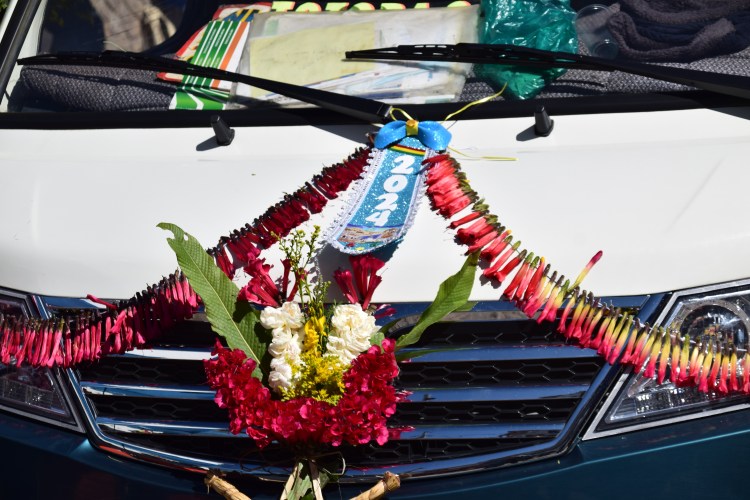
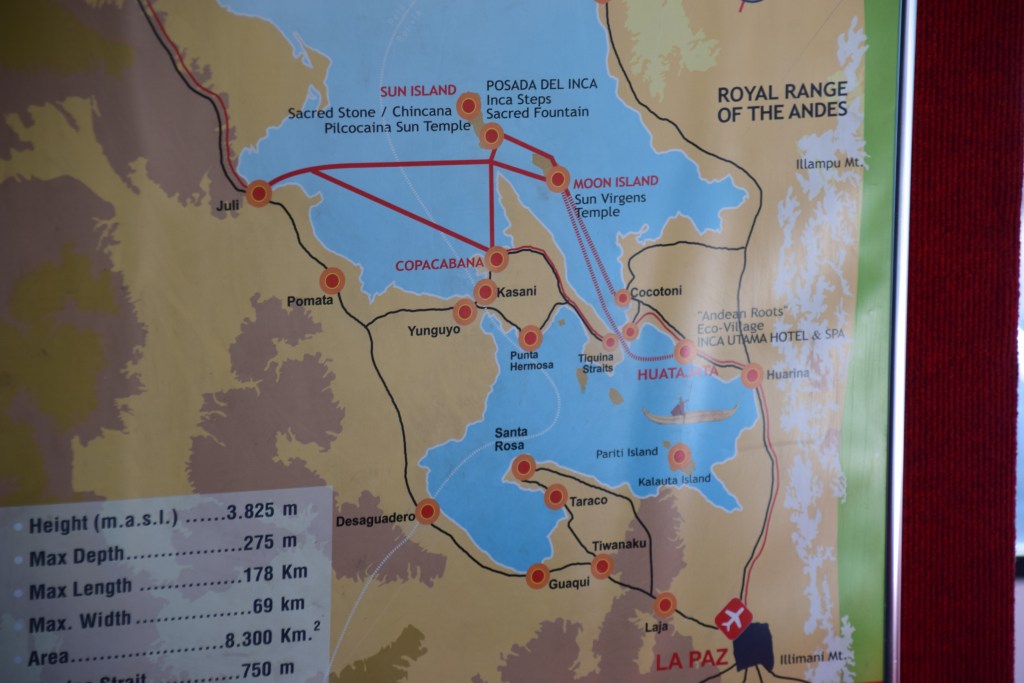
What a great introduction to a new country! We’ve just crossed the border from Peru into Bolivia and are making our way through the town of Copacabana towards the boat which will take us to Isla del Sol on Lake Titicaca.
We stop to look at the Basilica of Our Lady of Copacabana – the Patron Saint of Bolivia. Serving as a protector of travellers and children, the Virgin’s shrine has long been a place of pilgrimage for humans and the animals they use for conveyance. Of course, animal transport has been largely replaced with motorised alternatives and so the ritual has followed suit- transferring the blessings from llamas to cars in a ceremony in the adjacent plaza!

We’ve timed it perfectly for today’s ceremony. Rows of cars are lined up and awaiting the blessing. Garlands of flowers, car-sized rosaries, streamers, hats, bows, pom-poms… no panic if you you’ve forgotten something – the market stalls will have what you need!
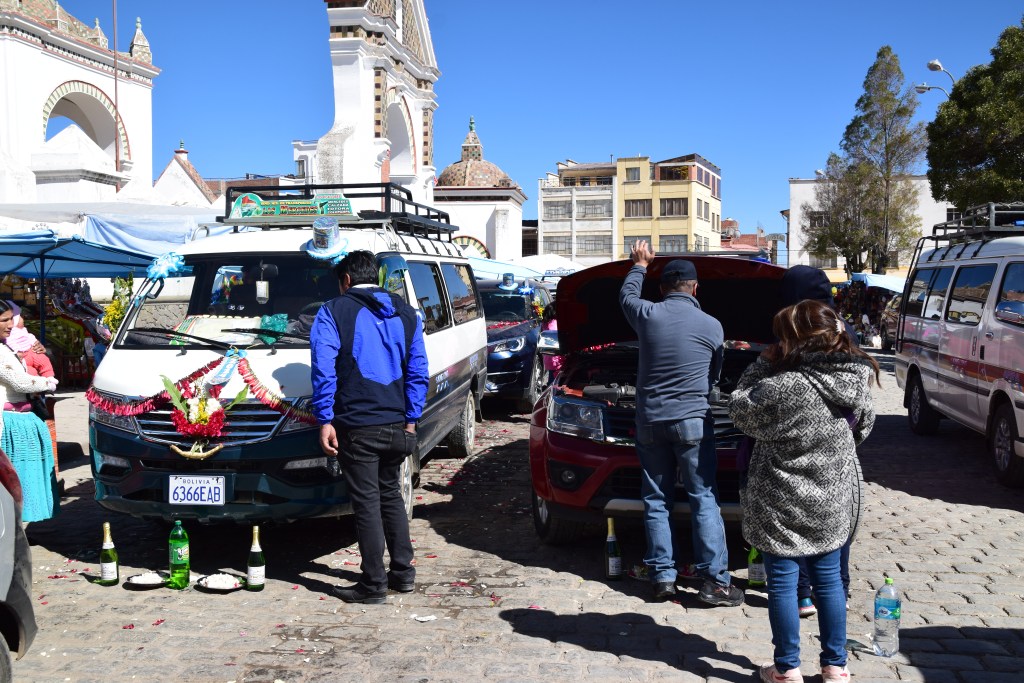
Not every car is spanking new of course – but it’s new to the driver standing proudly alongside. This first road trip – often of considerable distance – has been made to Copacabana to ensure the safety of all journeys.
The atmosphere is festive – but sincere and one of utmost respect – Bendición de Movilidades is a big deal. The drivers, often accompanied by the extended family in their finest clothes, are busy polishing and adorning their vehicles (inside and out) as they wait their turn.

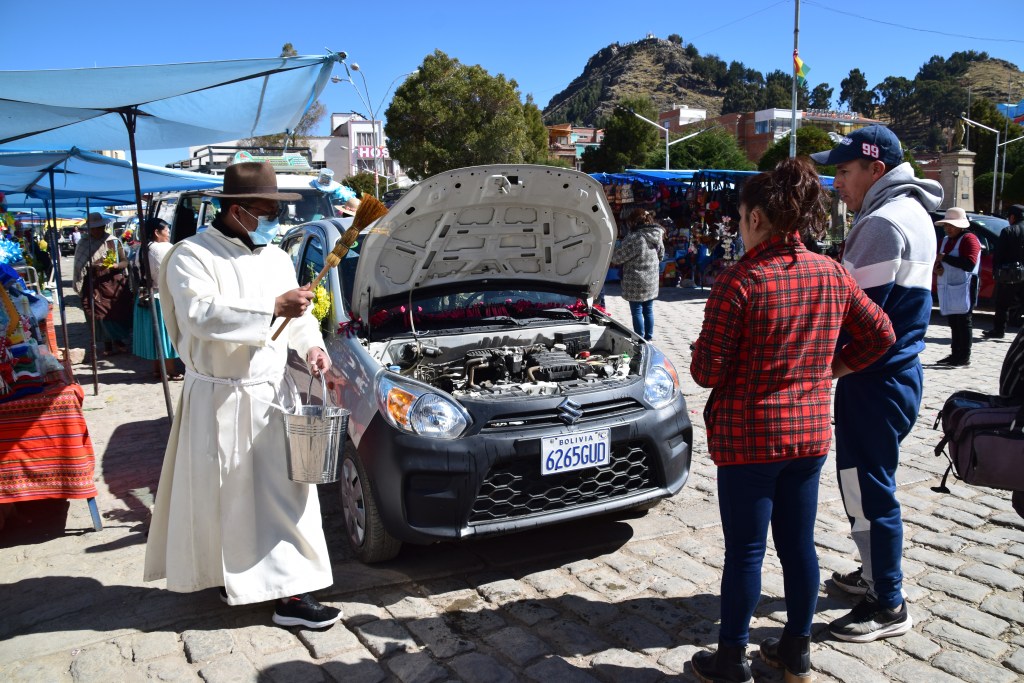
Finally the priest arrives and the ceremony can begin. He engages in silent prayer with the car’s owner and family in front of the open engine hood. He sprinkles, with holy water, the engine and any additional objects that are laid upon it or on the ground in front of the car. He then goes around the car, sprinkling all sides as well as the interior, before blessing the family and perhaps posing for a photo – there is a professional photographer close by if desired. A donation changes hands and the priest moves on…
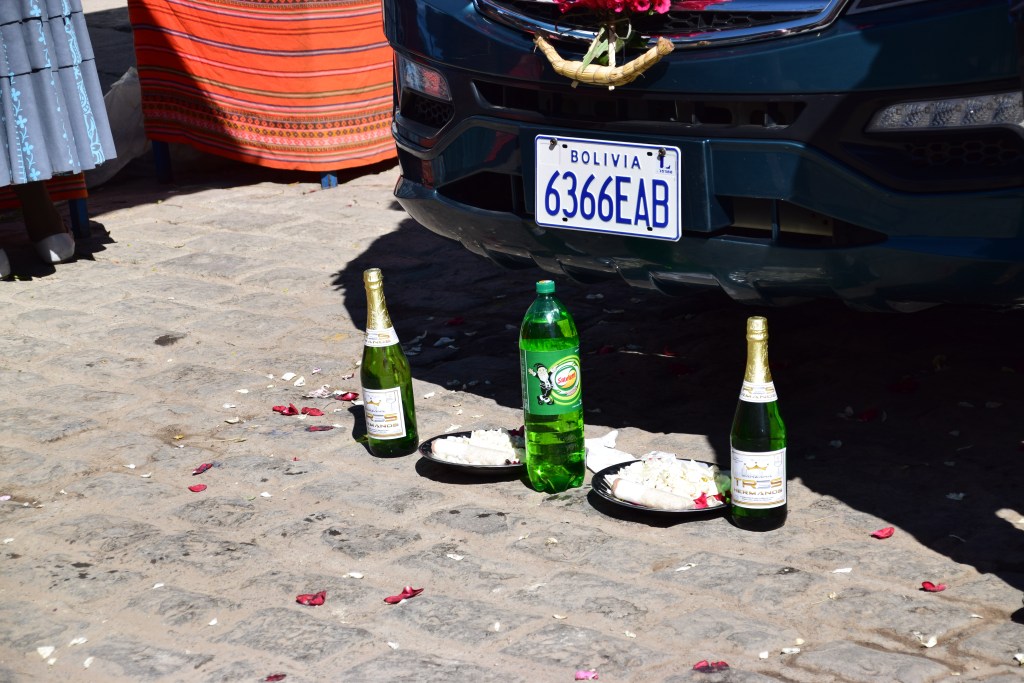
As he moves to the next car, the celebrations begin behind him! Depending on ones taste – and budget! – either bubbly or beer or coke is opened ( having been blessed of course!). Some is sprayed onto the car, the rest is reserved for drinking. Yellow flower petals or confetti are thrown at the blessed car, creating a rather sticky mess. Of course, it’s important that the petals stick – then everyone you pass on the way home knows where you’ve been! (Yellow represents luck and is associated with nearby Isla del Sol, Island of the Sun). A string of firecrackers is tossed under the car as the ritual is complete!
I wonder whether the newly bought divine car insurance extends to driving the vehicle home after all the celebrating!!
Isla Del Sol is where Viracocha, the sun god, created the first Inca man and woman. Ancient pilgrims established holy shines on the island and around Lake Titicaca. The Spanish later built churches on top of these holy places but they did not destroy them – anyone wanting to visit their shrine would just have to come to a Catholic church. A new religion was replacing the old but there was also a blending of the two spiritual beliefs and an evolution of unique traditions.
In the late 16th century, a devout Copacabana resident (of Inca descent) wanted to make a statue for his town after being inspired by one he saw in La Paz. When all his efforts were rejected by the clergymen, he travelled some 400 miles to Potosi to learn the art of sculpting from the masters there. Eventually Tito produced his own wooden masterpiece and carried it back to the town – on foot! – where it was accepted by the church. The Virgin of Copacabana was quickly accredited with miraculous powers, so much so, that a basilica was built in her honour in the middle of town.
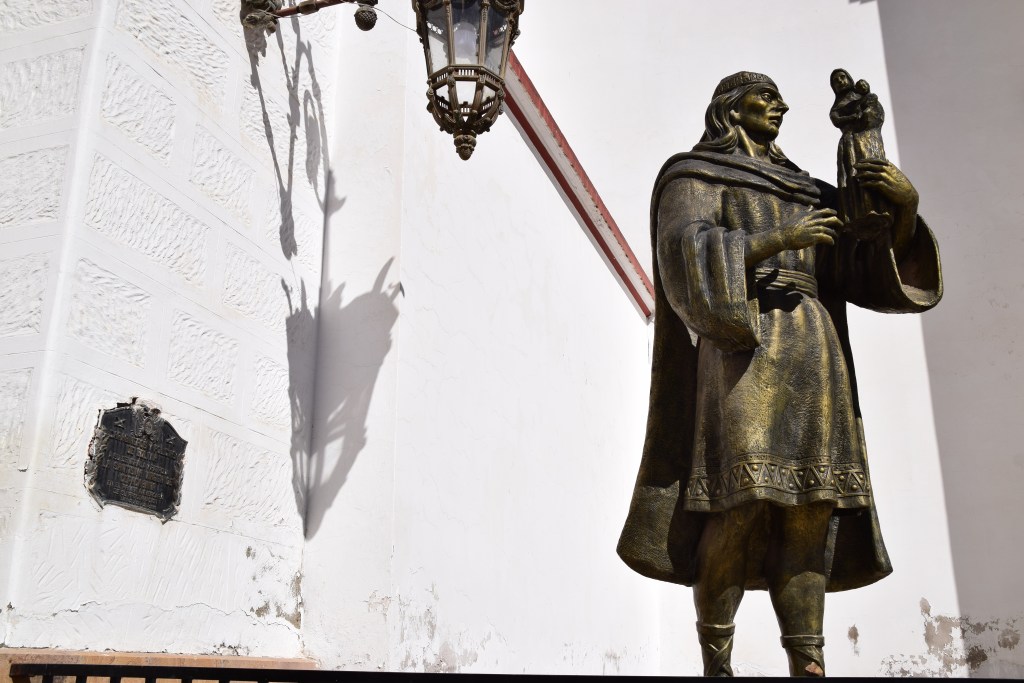
The basilica was ransacked, and artefacts stolen, during the Bolivian War of Independence although the robbers were careful not to damage the Virgin – affirmation of the respect and fear that the statue now held. With independence in 1825, the Virgin of Copacabana was declared patron saint of the newly established nation.
Nowadays, the statue attracts thousands of pilgrims to Copacabana. The four foot carving is laminated in gold leaf. In keeping with that unusual blend of tradition, she wears the luxurious robes of a Inca princess. The original statue never leaves the sanctuary – a copy is used for processions. Her Feast Day is February 2nd which is celebrated with a local fiesta.
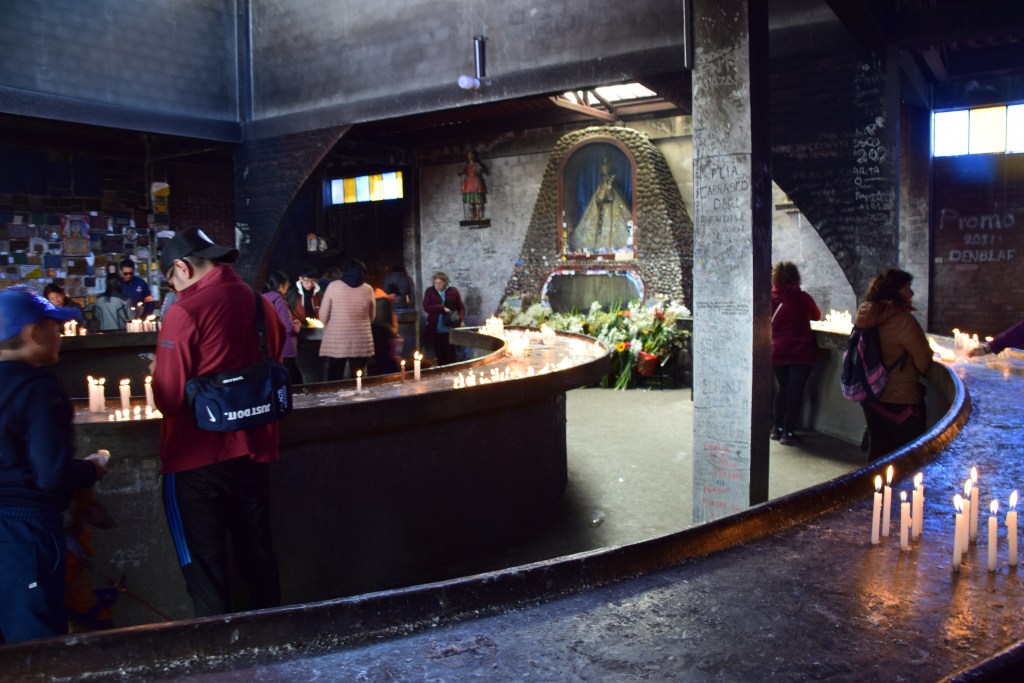
SO – WHO owns the name!!!
Copacabana, in the indigenous Aymara language, means ‘place near the water‘ – so the town was named for its location on Lake Titicaca.
In the 18th century, Bolivians and Peruvians merchants travelling to Rio to trade silver, brought with them their devotion to the Virgin of Copacabana, in the form of a replica of the statue in the basilica. A small chapel was built on a rock next to the beach, known as Sacopenapa at the time. Such was the devotion to the Virgin that the neighbourhood and beach was eventually renamed…. Copacabana!
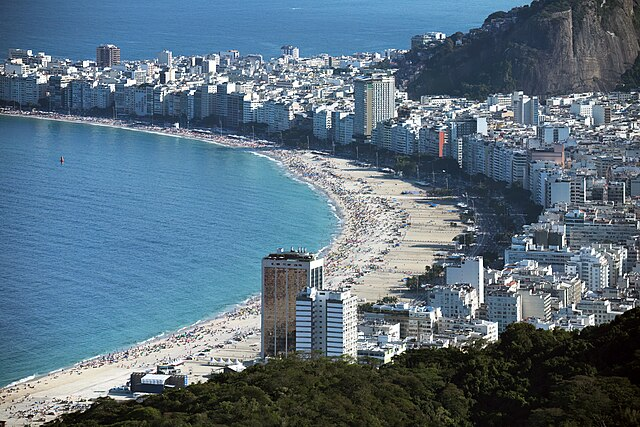
Courtesy, Wikimedia Commons
And then, of course, a New York nightclub took its name from the famous party beach…..
Which brings us to Barry Manilow, Lola, her beloved Tony and the nasty Rico!!! ( I bet you’ll be humming it all day now! Sorry!!!)
Wow memories of always in my American period visited them a lot cochabamba and La Paz but no pictures back then. Thanks for the memories enjoy it Cheers
What a fascinating and totally absorbing tale of a very unusual event. I’d never heard of this one but it sounds just the perfect thing to come across on a trip, the sort one finds just occasionally if one is lucky. Lovely to read and join in the experience with you. We never got to Lake Titicaca and I envy you that, but we spent nearly a month in Rio and its surroundings – including a fabulous all-nighter New Year’s Eve on the beach – so the final image in your blog brought back many happy memories.
Happy New Year Mari –
These unexpected events are always the best aren’t they… Imagine spending New Years Eve on Copacabana Beach!! Lucky You! I know never say never but not sure we’ll ever get to see it…
Two fascinating accounts, both the blessing of the cars and the history behind the Virgin of Copacabana and how the Rio beach town got its name 🙂 We’ve never been to Bolivia – there were early plans to do so as part of a trip to Peru but there was some trouble in the country and we were advised against it. I should put it back on the wish list as we’ve loved everywhere we’ve been in S America to date. I’ll look forward to hearing more about your trip!
I think you’d like Bolivia Sarah – the altitude is a challenge and we didn’t have enough time to do the country justice but we loved our time there…
In our church, we do a blessing of the backpacks for school children. I’d never heard of blessing cars, but it’s probably a good idea! I had some cars that could’ve used that. 🙂
Me too!!!! My first few cars were absolute bangers and totally unreliable. I eventually managed to buy a new one. I like the idea of the blessing of the schoolbags – as a retired teacher myself, I think it would be a nice thing to do at the beginning of the school year…
That made me smile! Honestly, you couldn’t make some of these ceremonies up, even if you were trying to create a satire on the whole concept of religion! Reminds me a bit of the village we visited in rural Mexico where they worship Coca-Cola and believe that burping rids the body of evil spirits. Of the two, I think I’d opt for having my car blessed. 😂
That Coco-Cola story MUST be a wind up!!!!😖😂 They reckoned these two English will believe anything!!!!😂 Mind you – I’m a bit of a Cola worshiper myself on a hot day!!
Absolutely NOT. We posted in detail about it. Visitors aren’t allowed in….you can Google it as well as our own post, it’s absolutely genuine! These things are stranger than fiction!
It’s a wonderful story!!! And much better than a car!! I love it!!
Seeing families dressed in their Sunday best poping Champagne beside cars speckled with pom-poms would make an outsider think that a wedding is taking place. But if the pilgrims can drive home feeling safer behind the wheel with their cars blessed, it’s all that matters, right! But I have to say that I have not heard of such an uncommon Catholic ritual as a car blessing 🥰 Thanks for sharing, and have a good day 🙂 Aiva xx
Everyone loves a celebration!
Hope all is ok with you in the west, Aiva and you’re avoiding the worst of the weather….
The school are closed, so we are enjoying a few days at home xx
Really interesting read, it’s nice knowing where perhaps the more famous Copacabana gets its name!
Also I do not envy that walk back to Copacabana but it’s an incredible story!
Thanks Jason. We were rather chuffed that this was the original town rather than called after the beach!
I went through a similar ceremony of blessing cars in India. Flowers were flown everyone around the vehicle. Good idea to include a map of the Lake Titicaca region.
I love coming across local or regional traditions when I’m away – especially when I’m not expecting it. I realised that most readers wouldn’t be able to pinpoint where I was so the map came in handy when I came across it in my photos… I usually photograph any maps I come across but generally they are illegible and immediately deleted once I’m home!