

I know I go on about those people who blow in and out of a place in 5 minutes and think they’ve ‘done’ it. But, I’ll admit, there are times when that’s exactly what circumstances throw at you and of course you make the most of it.
It’s amazing what you can do in a day, isn’t it – but it must be planned. This isn’t the time to be fluting over a map in the tourist office – especially in winter with the shorter days and darkness by 5.00pm.
So, with flight and accommodation sorted, what else…
There’s transport, the main sights, Sound of Music, Mozart and Strudel – that should do it!
*Transport – how exactly to get from the airport – the Number 10 bus from the airport drops us 2 minutes from the hotel. Ticket machine at bus stop.
On the following day, we can walk – 23 minutes to Salzburg Hbf – for our connecting train. Buy tickets at the station.
*Main Sights – mightn’t have time to tie in with a walking tour so read up on a few blogs and work out a self-guided route.
*The Sound of Music – well – unless you need the full experience (which we don’t!), a few landmarks along the way will be fine.
*Mozart – check out any events on the day of your visit – maybe prebook (which we did!!).
*Strudel – You can queue at Tomaselli’s (or maybe just nip in anywhere with a free table – especially if it’s January and it’s freezing!)
Why NOON to NOON you ask?
A 7.15am flight from Dublin meant we were already dropping our bags at the hotel by 11.45am (not bad!). Our connecting train the following day was at 1.00pm – so allowing a half hour for the walk to the station and purchase of tickets, we’d in or around 24 hours to make the most of the city.
A few things in context–
My camera died upon arrival so all photos are from Tom’s phone.
In early January, the xmas markets have not all been removed, still making it difficult to fully capture the beauty of many of the squares…
Low winter sun (which is gorgeous of course) cast some harsh shadows across buildings that I wouldn’t have time to revisit in better light.
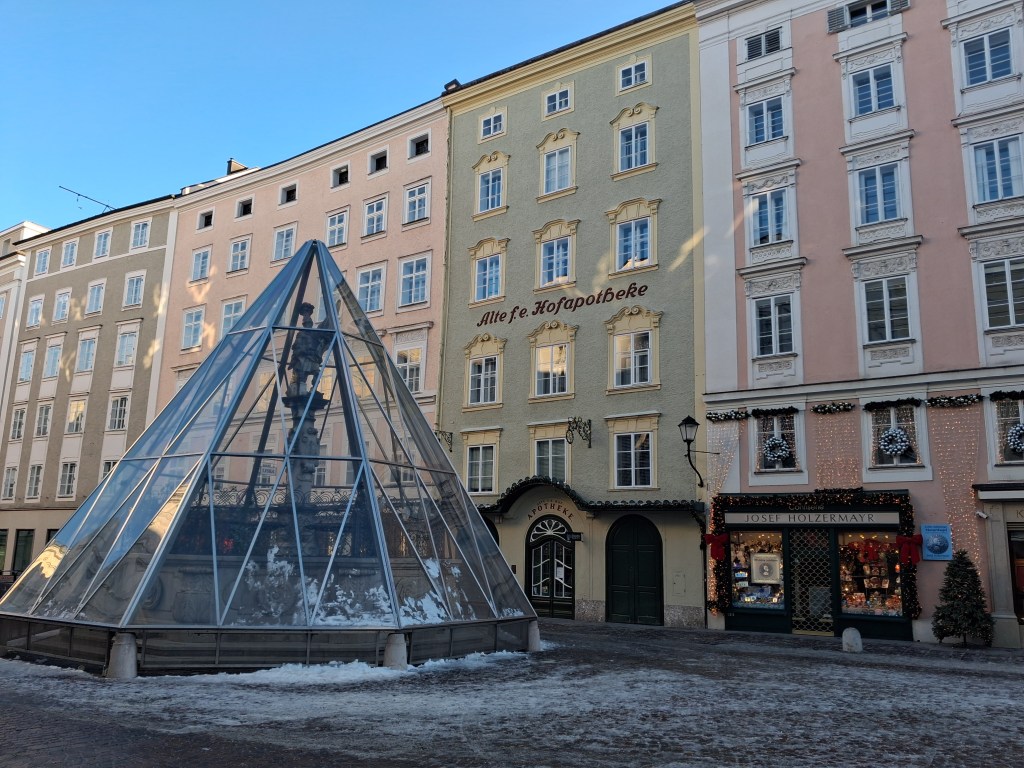
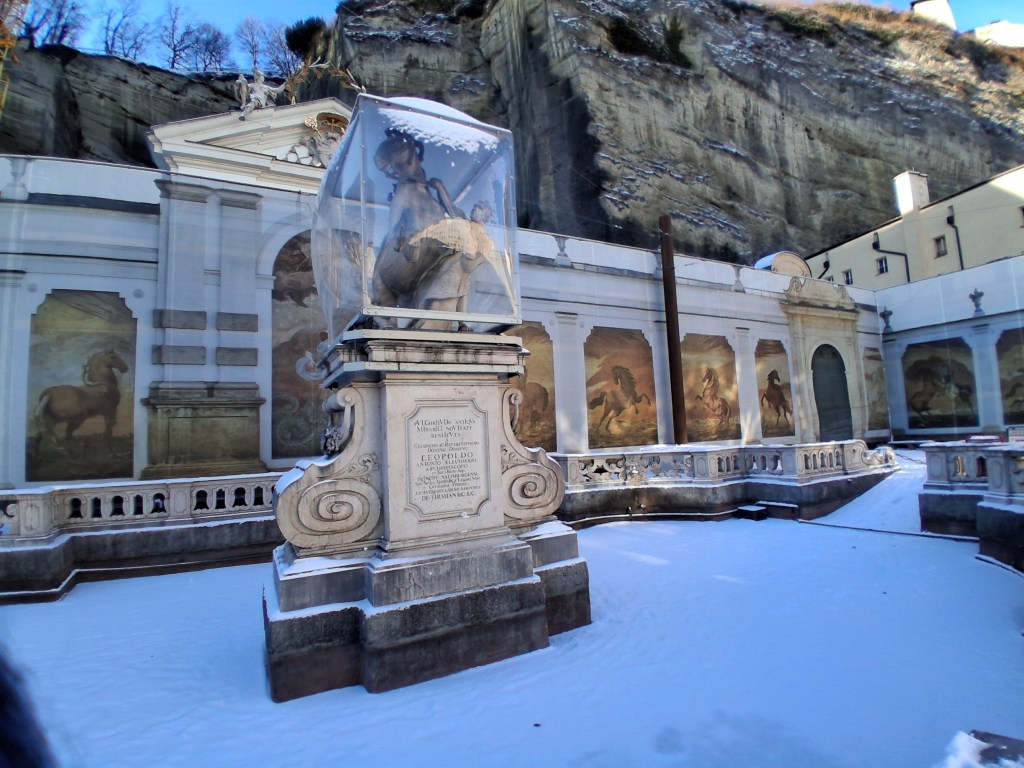
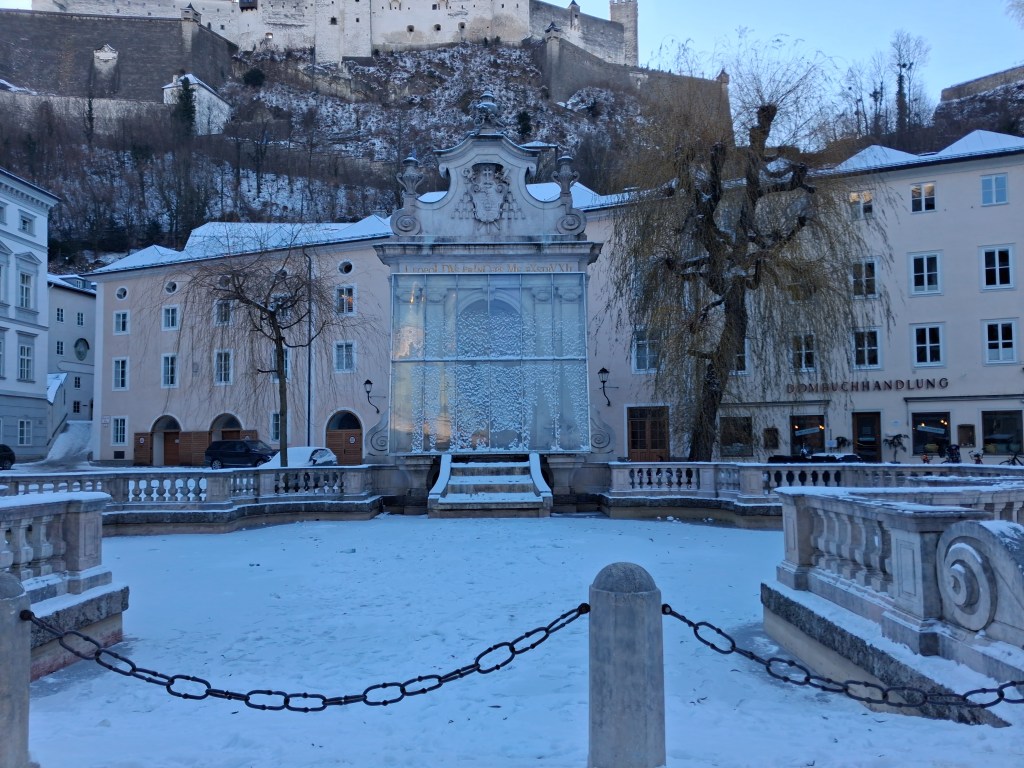
Many fountains and statues are covered with glass pyramids in winter to protect them from harsh weather.
The following route(s) follow a rough circular route around and through the city centre. Spread over the two days, we pass through some parts more than once so ignore the lack of continuity in photos, light, etc!!
A Potted History in 10!
*1. The city owes its name to nearby salt mines: SALZ = SALT and BURG = CASTLE /FORTRESS (presumably referring to the fortifications built to protect the profitable resource although BURG can also mean settlement).
*2. The first settlers date back to the Neolithic Age – they discovered that salt could be used to preserve meat. There is archaeological evidence of early mining and trading in the valuable commodity.
*3. The Celts lived in the region from the 5th century BC and mined salt intensively, trading this white gold far beyond the local area.
*4. The Romans arrived in 15BC, their settlement of Juvavum serving as a critical trading route linking Europe with the Mediterranean. They built roads, bridges and public buildings while salt continued to play a crucial role in the city’s wealth.
*5. The city slowly lost its importance after the fall of the Roman Empire but as it drifted towards the Middle Ages, it emerged as a religious stronghold. 696AD saw the construction of its first Abbey by St. Rupert and the city went on to become a bishopric in 739 and an archbishopric in 798. In 1278, the archbishops were acknowledged as princes of the Holy Roman Empire.
These ecclesiastical leaders were not only religious figures but also wielded considerable political power in the region. They carefully controlled the salt trade and the generated wealth allowed them create one of the most magnificent Baroque cities of the Empire. They commissioned churches, public squares, fine gardens and fortifications. They founded a university and heavily promoted the Arts – a 1700’s cultural explosion defined in particular by one Wolfgang Amadeus Mozart.
*6. The golden age couldn’t last forever – by the beginning of the 19th century, a move towards secular authority saw the archbishops lose their power. The city changed hands several times during the Napoleonic Wars before being annexed into the Austro-Hungarian Empire in 1816 where it suffered a long decline – both economically and culturally.
*7. Things improved at the turn of the 20th century and the city became fashionable again between the World Wars – attracting visitors from Vienna and Germany. Austria was annexed by Nazi Germany but the old town was largely spared destruction during the war.
*8. After WWII, Austria was occupied by the Allies for 10 years before regaining full independence in 1955.
*9. The post-war decades brought rapid tourism growth and economic revival to Salzburg.
*10. The historic old town was declared a UNESCO World Heritage Site in 1997.
And so – we’re off
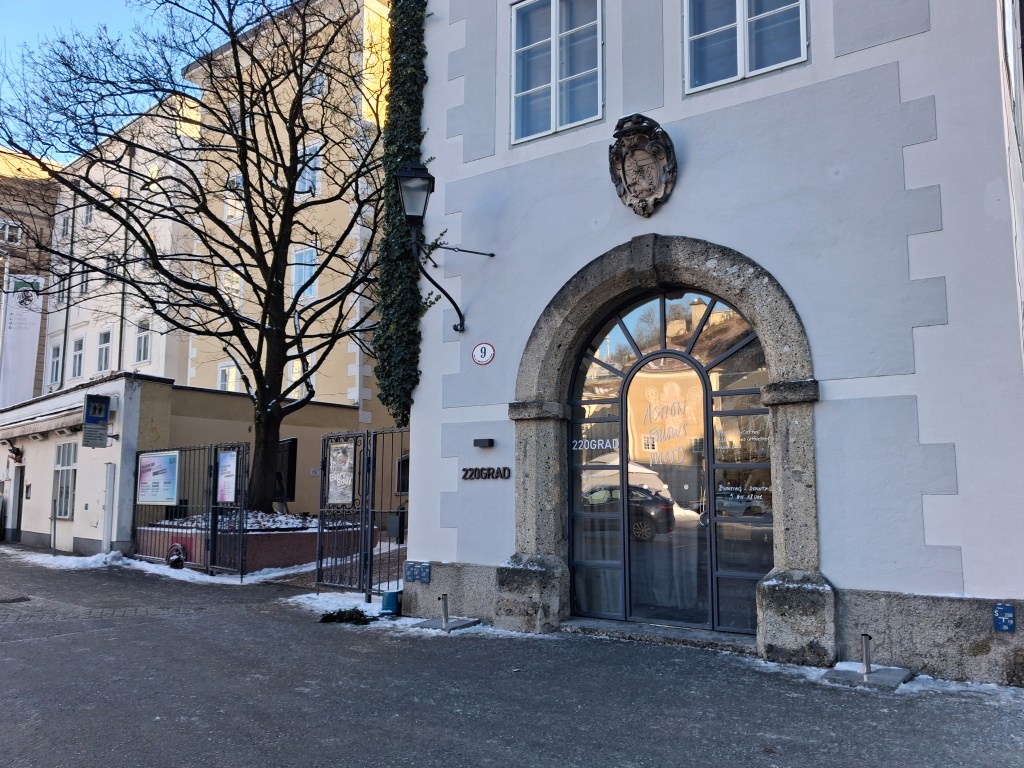
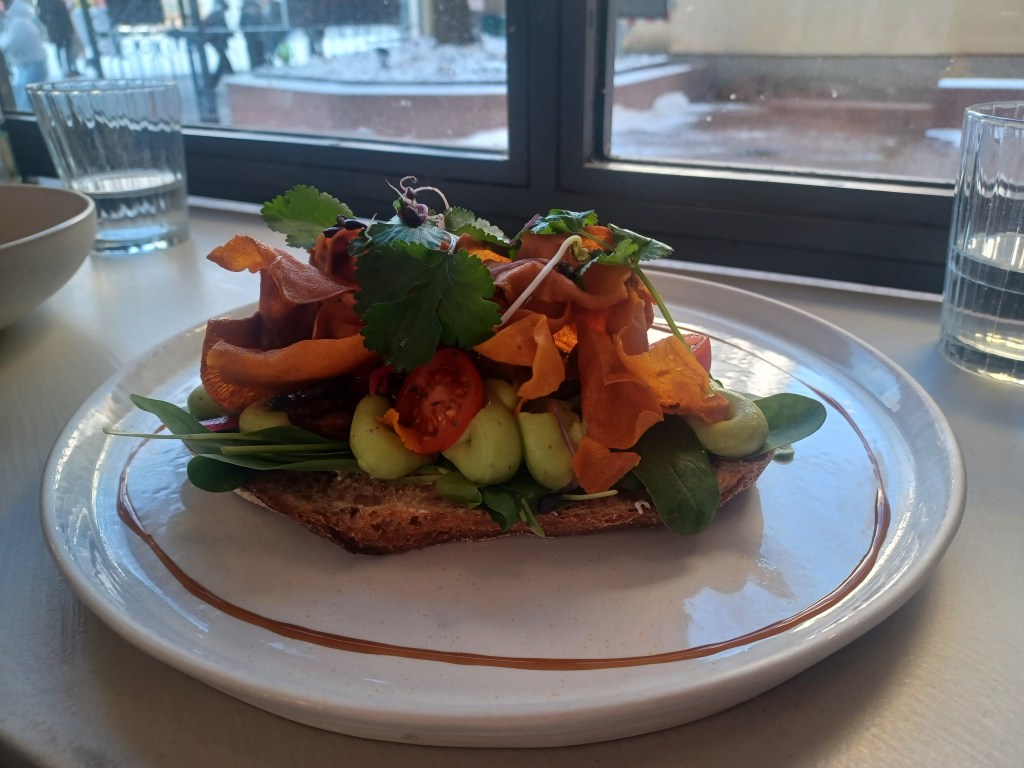
Well – not exactly – first there’s lunch (come on – it’s been a LONG morning!). There are three 220GRAD coffee establishments in the city and one of them was 2 minutes from the hotel. They are hugely popular and, as we were ahead of ourselves timewise, we were prepared to queue if necessary on a Saturday lunchtime. The place was very busy but turnover is fast enough and we’d seats within 5 minutes. Over french toast and smashed avocado, we congratulated ourselves on an incident free journey and watched the weekend clientele meet up with friends or just order coffees to go.
OK – now we’re off!!
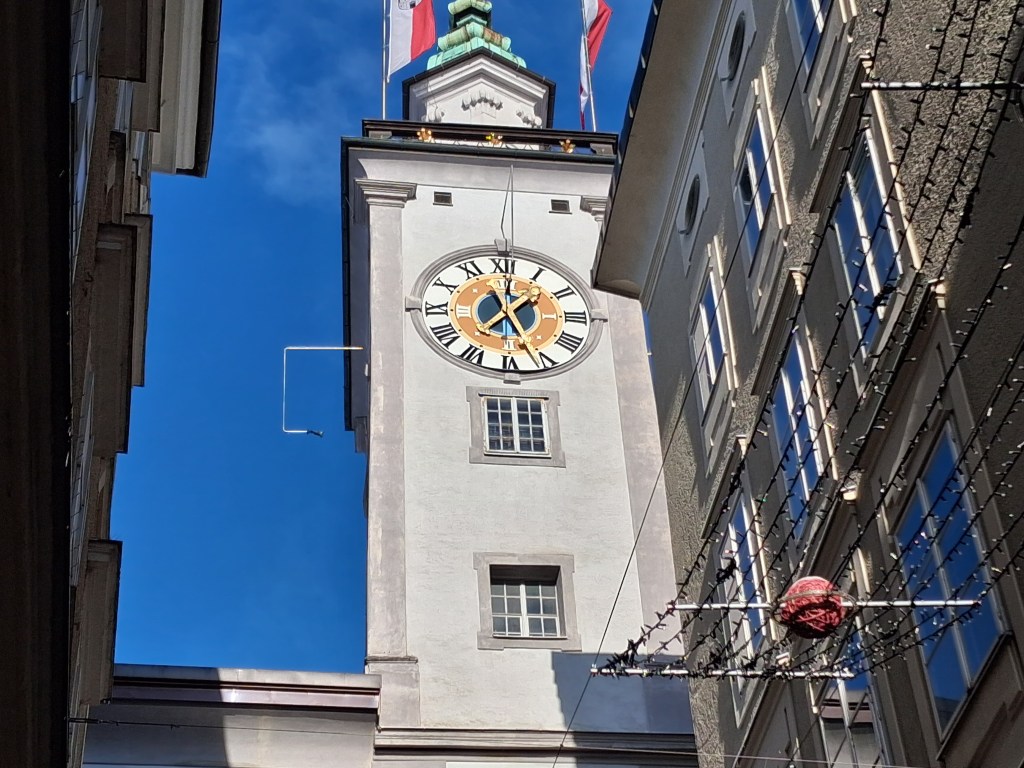
Our hotel is so central – when we step out onto the lovely Sigmund-Haffner-Gasse, we immediately spot the Altes Rathaus (Old City Hall) at the end of the street.
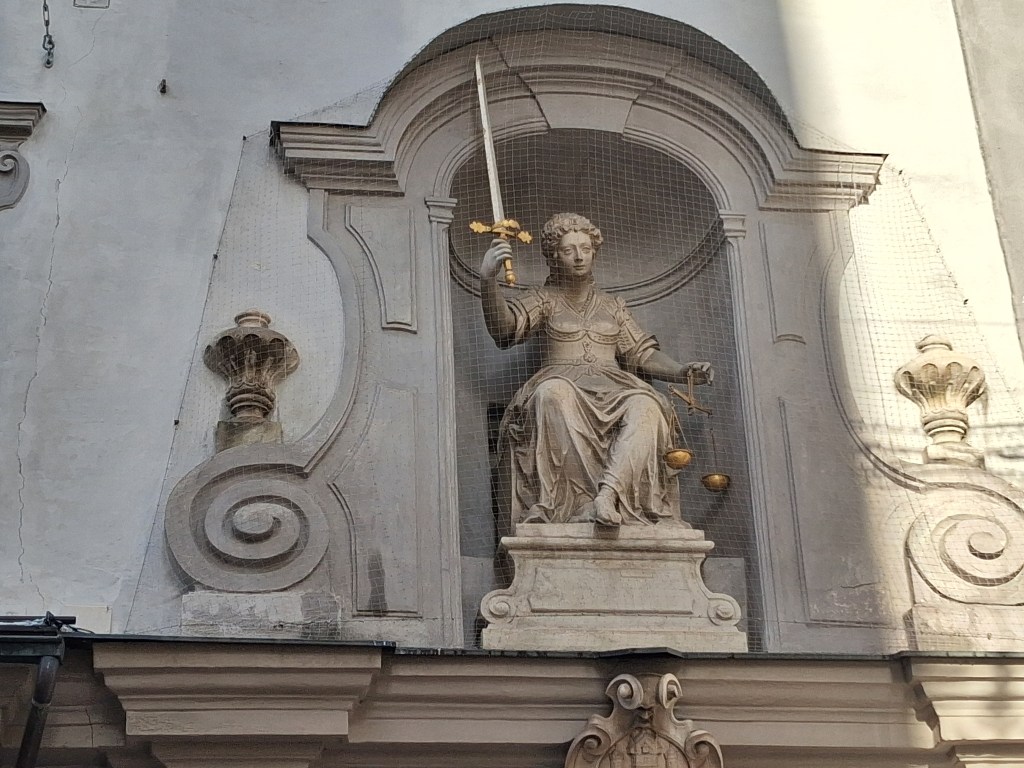
This was originally a burgher house (free citizens as opposed to peasants who were tied to the land they worked) dating back to the 14th century. The city council purchased it to fulfil many functions – it served as a courthouse (indicated by the Justitia statue above the entrance). The bells marked the nighttime curfew, the tower served the night watch and the clock (probably the oldest in Austria) provided a reference for time. The city clerk, midwife and preacher all had their official lodgings here.
The building was nothing as fine as the archbishops’ residences – the mayor and city councillors were useful in case of riots or siege but otherwise their powers were restrained. It no longer serves as city hall but houses a gallery and meeting rooms.
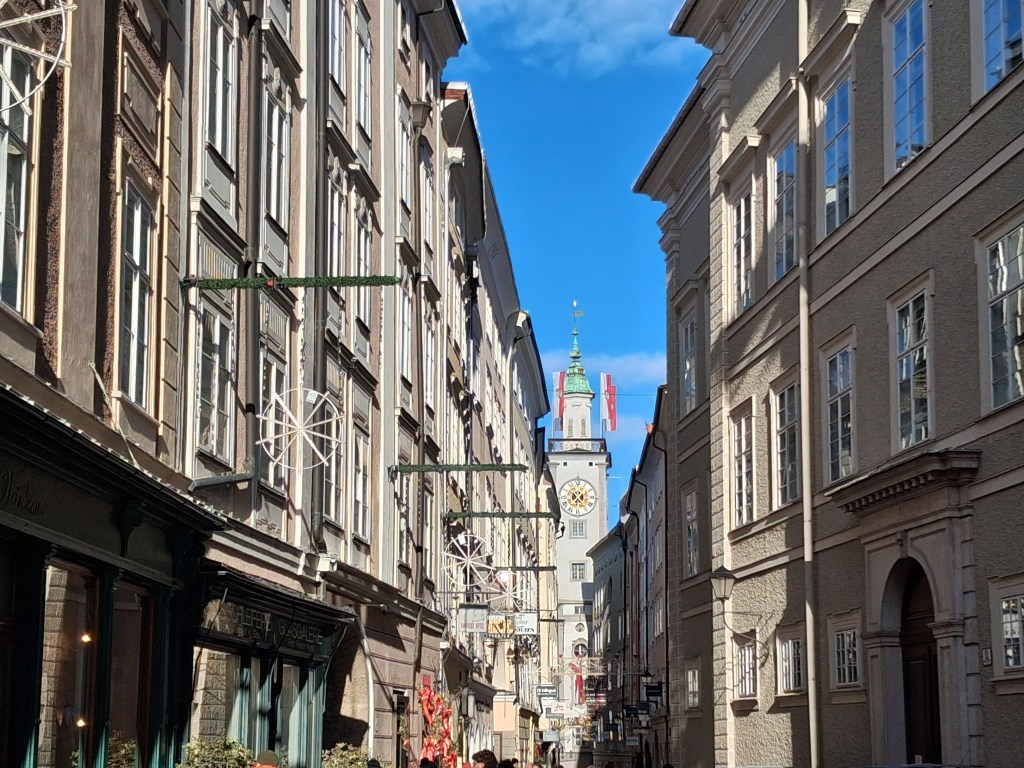
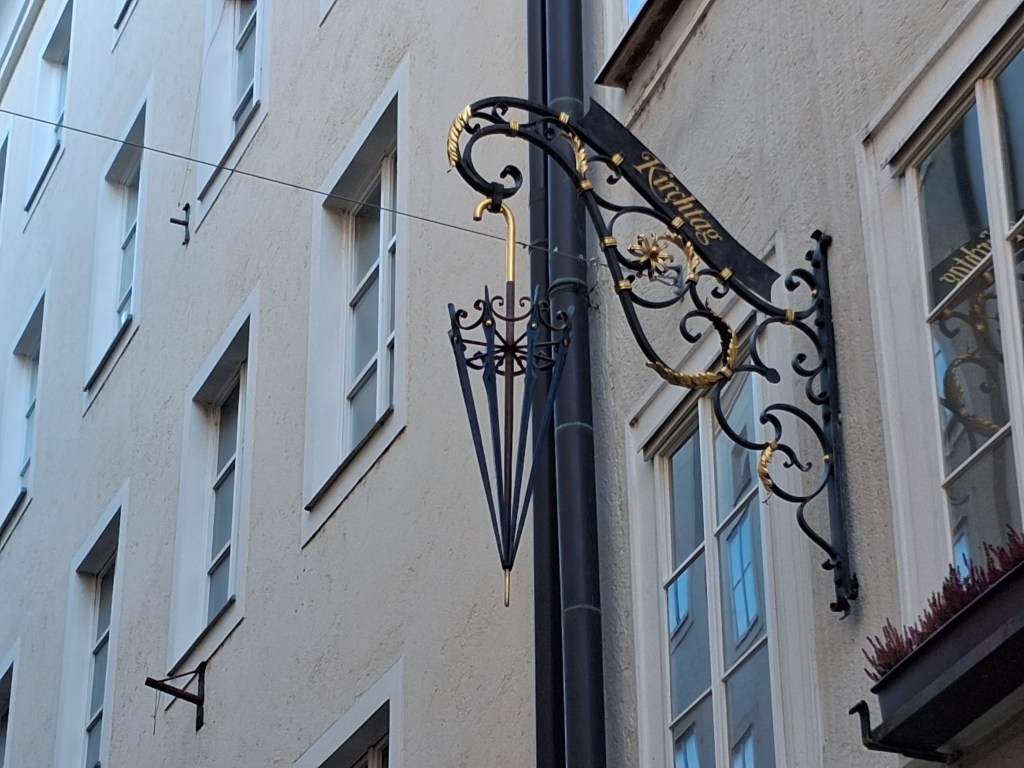
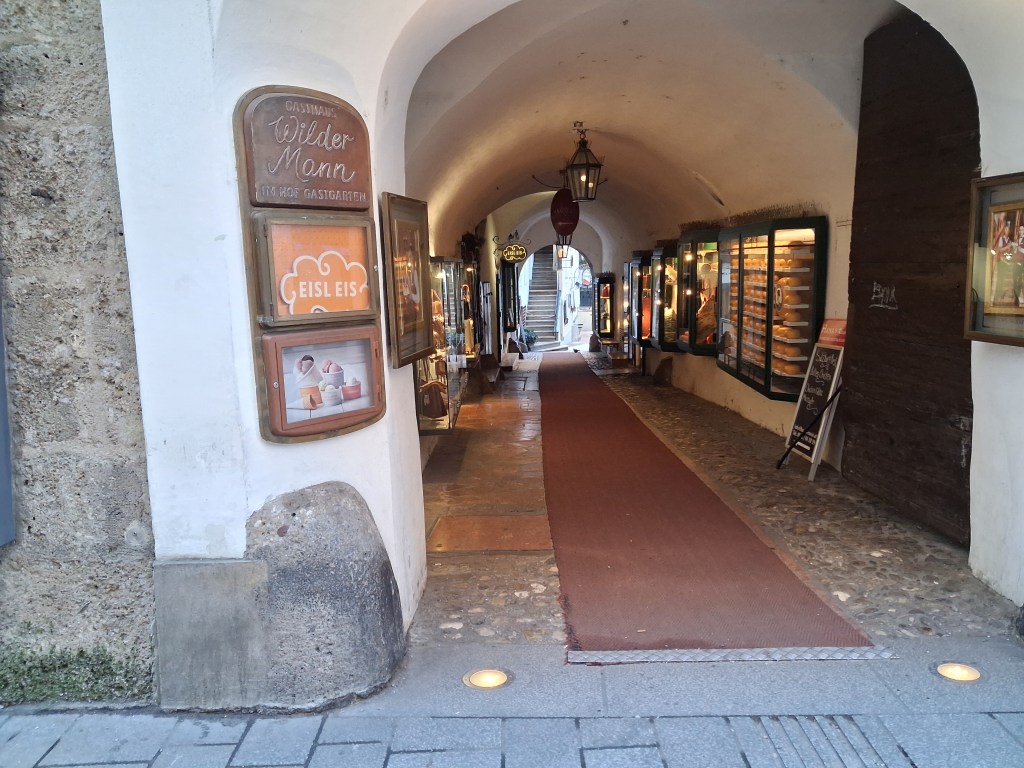
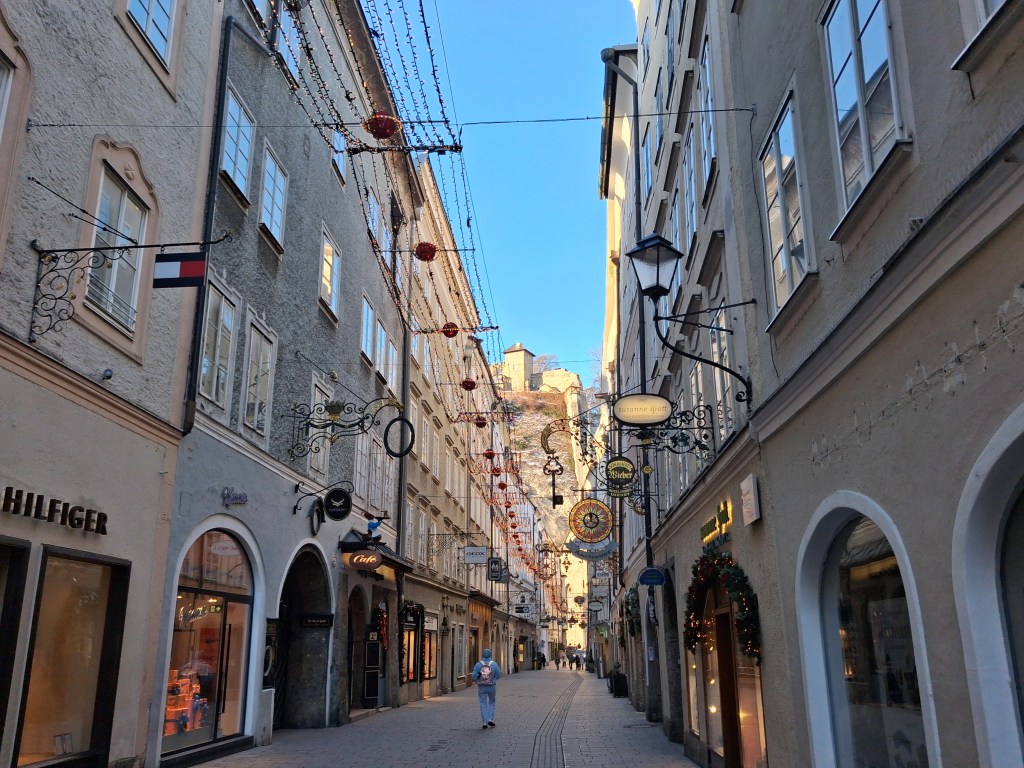
Getreidegasse, lined with beautiful old buildings, is particularly noted for its intricate wrought-iron signs and its through-houses where the front and back of the buildings open onto different streets with a passageway connecting the two.


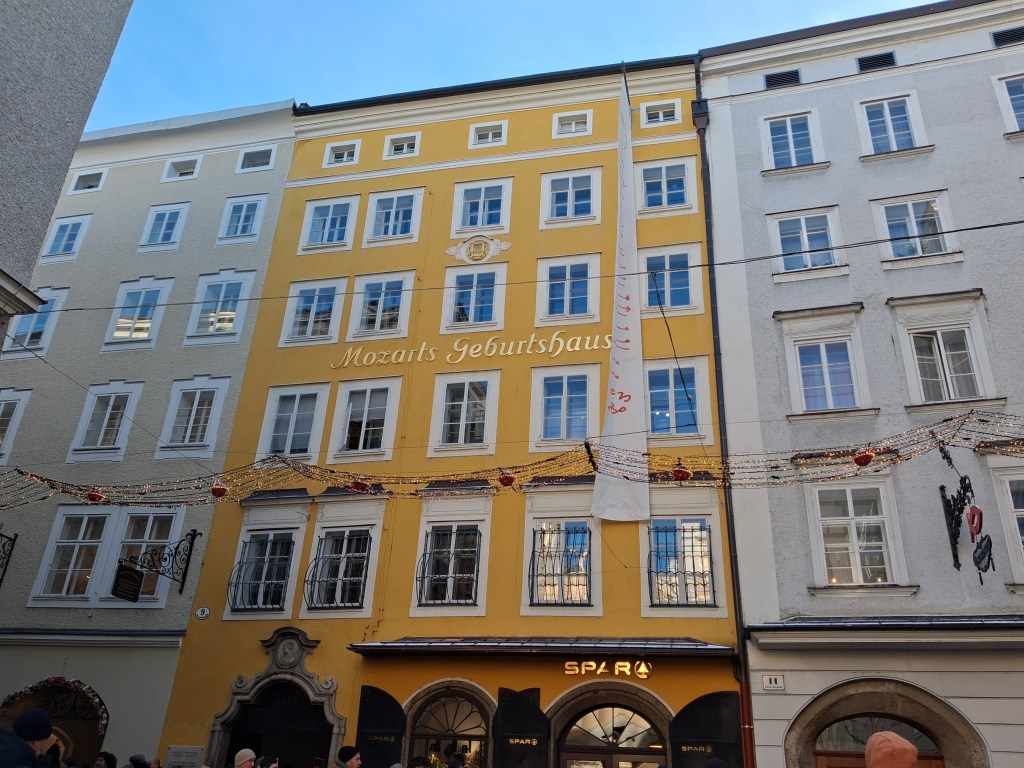
Wolfgang Amadeus Mozart was born in number 9 on January 27, 1756. He lived here for several years before his family moved across the river. The house features historic furniture, letters, memorabilia and childhood musical instruments.
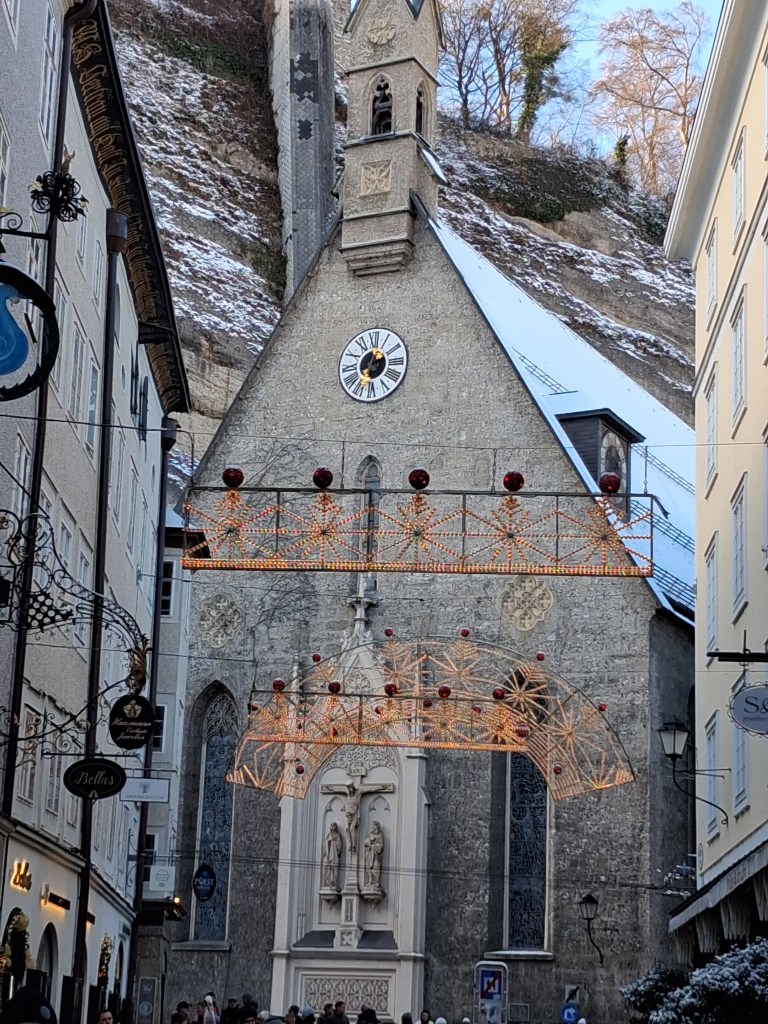
We’ll come across plenty of churches on our walk but the lovely Kirche St. Blasius is located at the end of Getreidegasse and worth a peep. There was an old 12th century church here dedicated to Blasius – the patron saint of throat ailments. The archbishop established a hospital on the site and the townsfolk provided food for the patients. This church replaced the old one in the 1300’s.
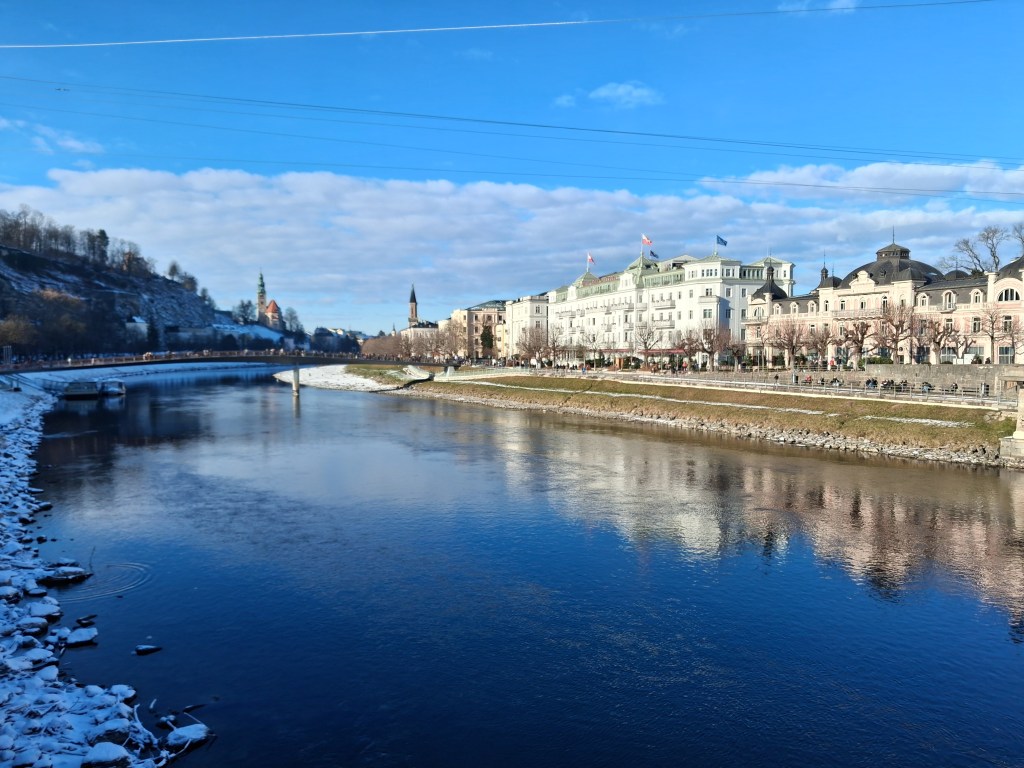
We’re going to leave the old town for now and head across the river….
The Salzach is served by several pedestrian bridges – someone around here is making an absolute fortune on love locks!!!
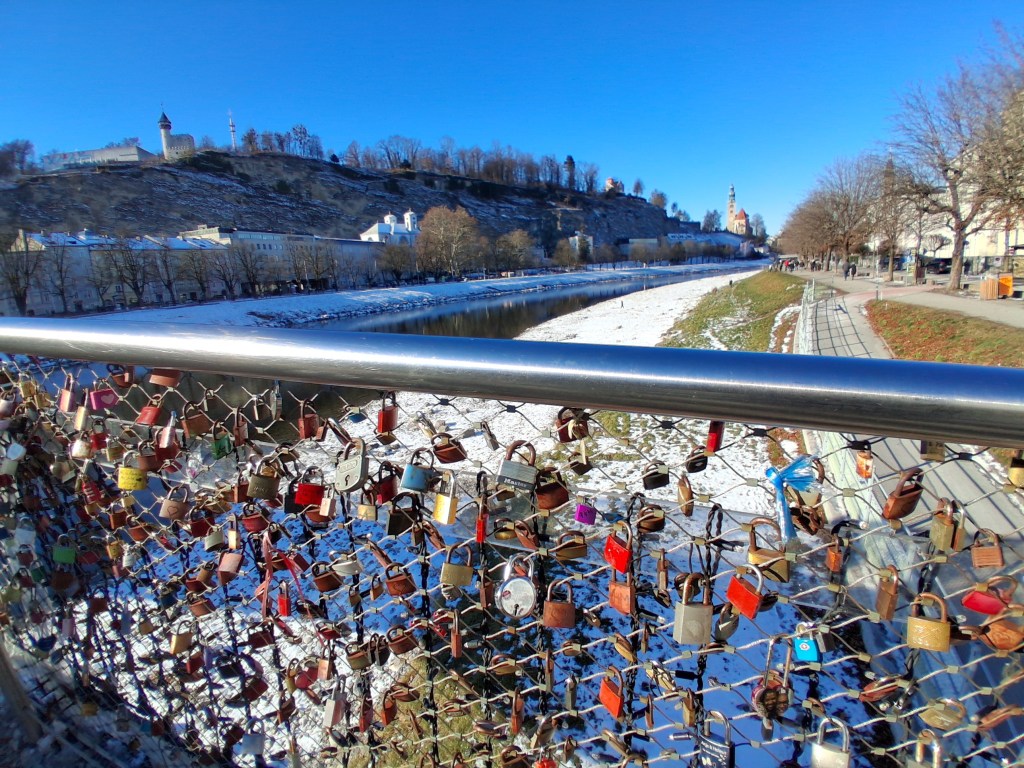
There are lovely riverside paths and benches but even though we’ve crossed to the sunny side of the waterway, we’re not lingering – we haven’t time – and it’s bloody freezing!!!
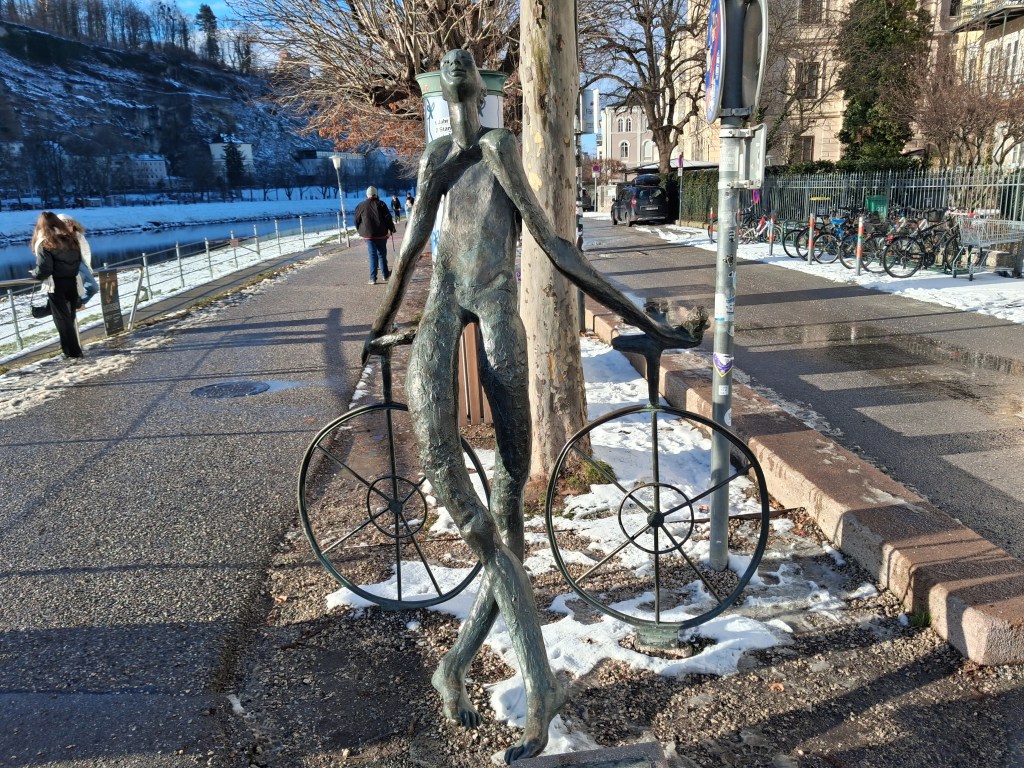
Don’t let him fool you!
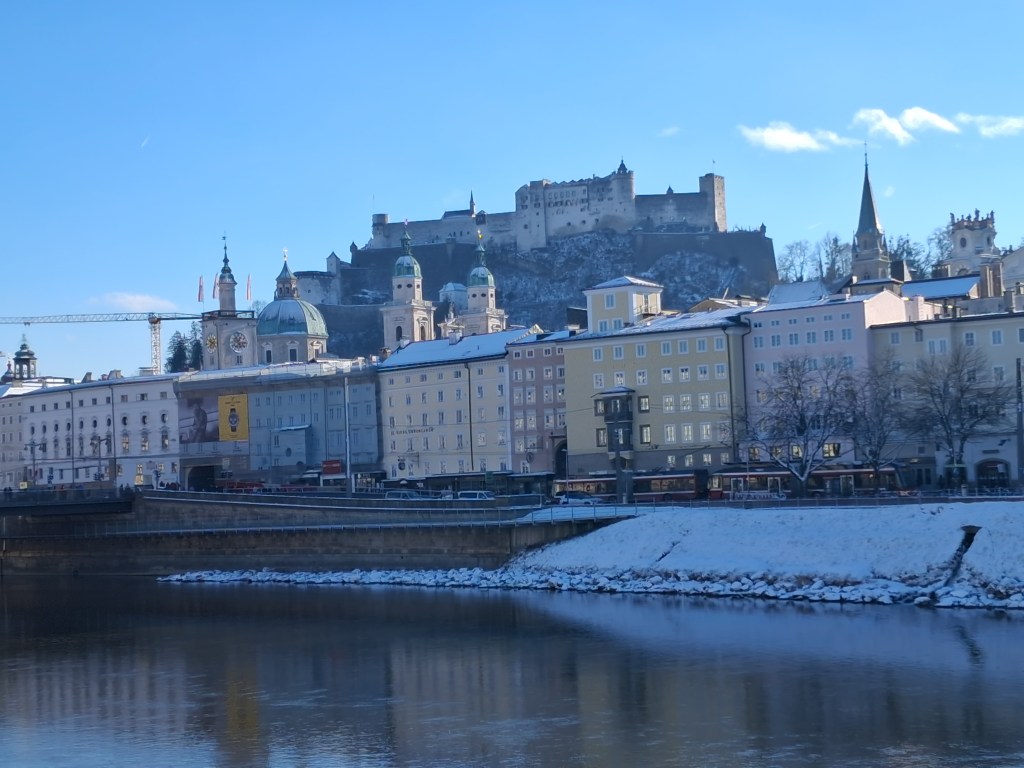
We can look back across at our first proper view of the fortress though…..
The Hohensalzburg Fortress is one of the largest castles on the continent and the largest preserved fortress of central Europe. Construction began in 1077 and successive archbishops expanded it considerably over the following centuries. The aim was to protect the principality and the archbishops from attack. To date, it has never been captured by an enemy!
A visit is recommended, not just for the views, but for the several museums housed in the castle. You can walk up if you wish, but most of us mere mortals will settle for the funicular which has been in operation since 1892 (not the same one obviously! – the modern version takes you to the top in 54 seconds!)
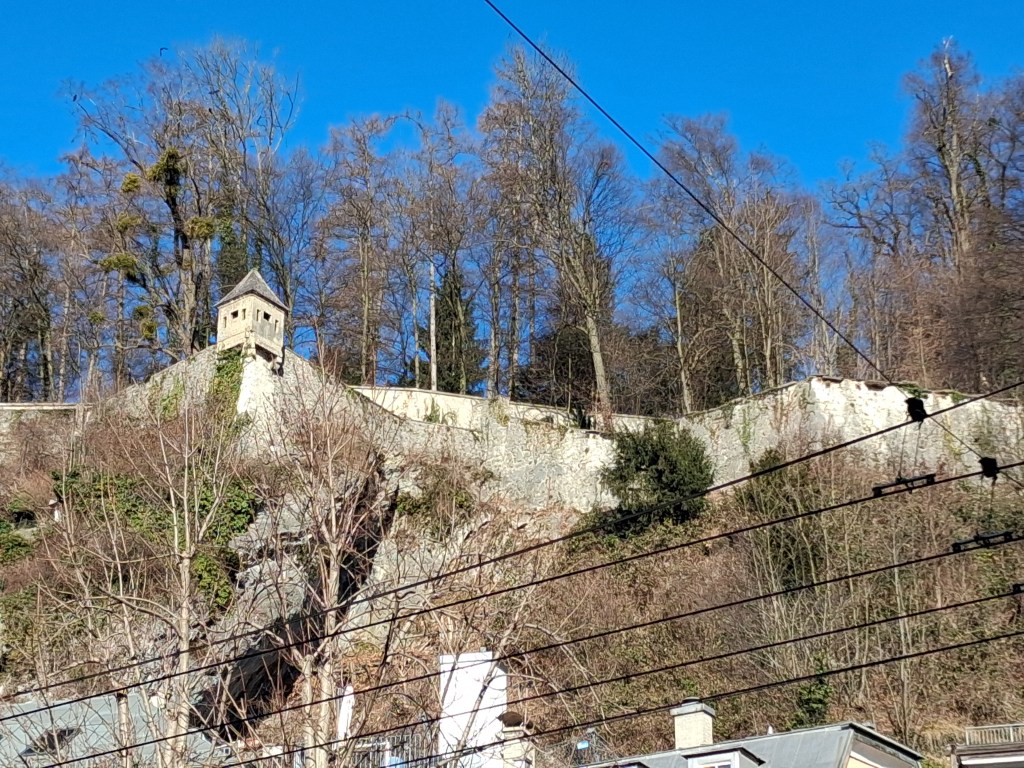
Above us, on this side of the river, the old city walls and towers stretch out along the hillside….
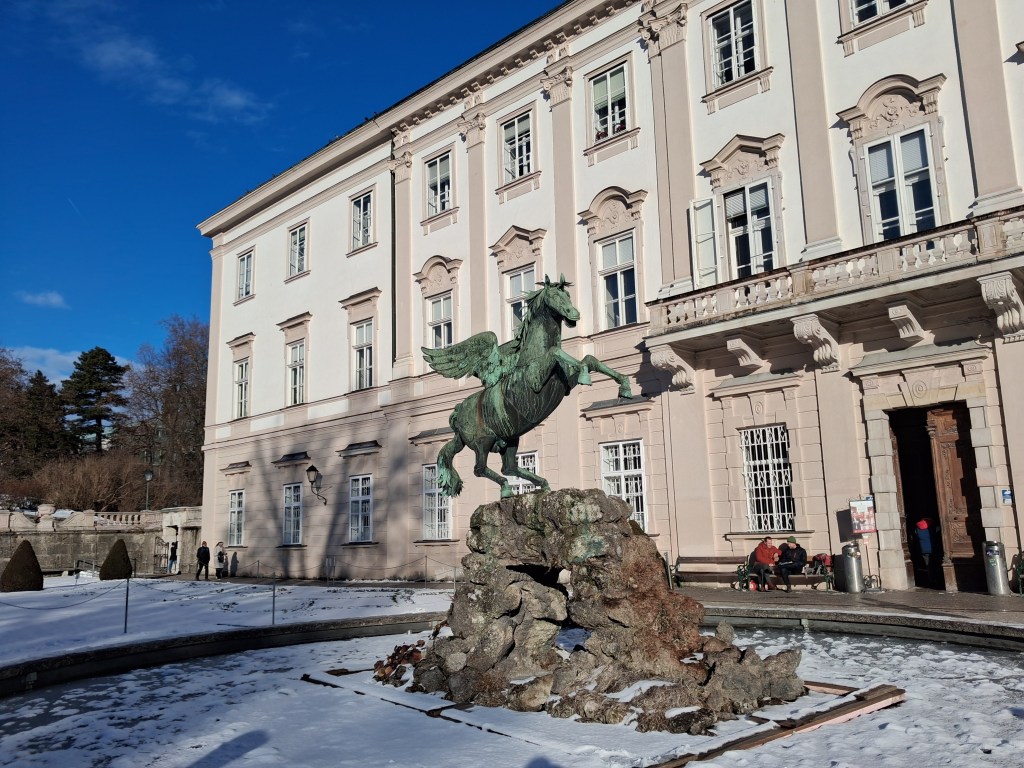
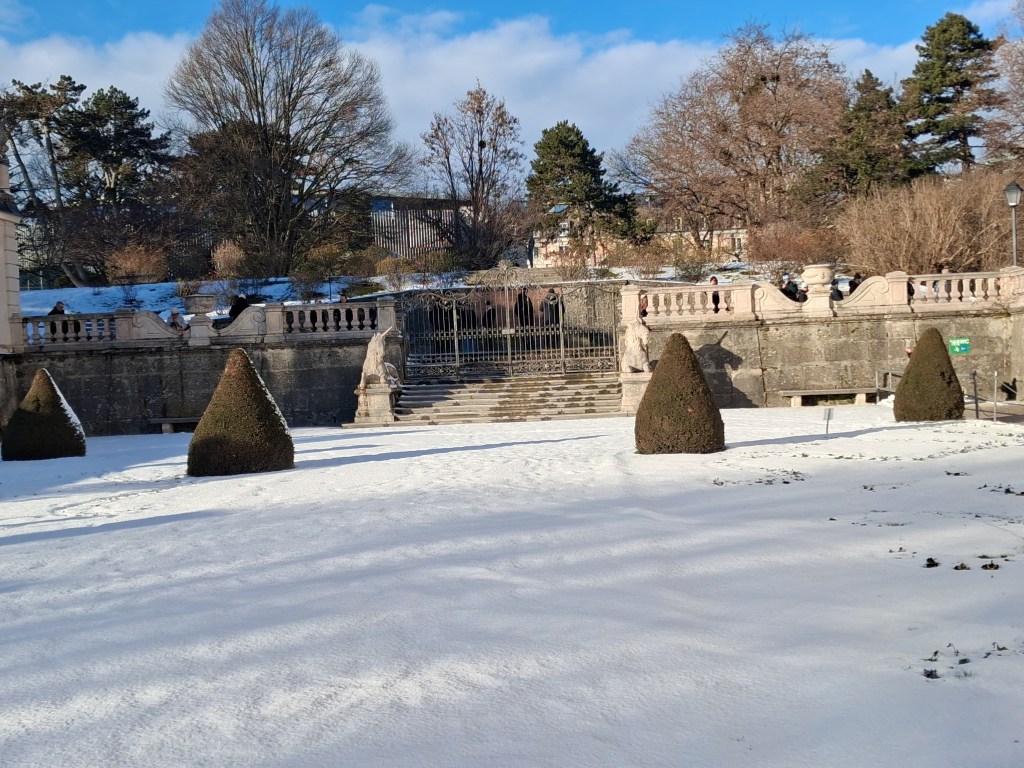
Schloss Mirabell was built in 1606 by the prince-archbishop of the time for his mistress and their 15 children. (Alas, mother and children were all banished from the palace by his successor!!). Today, the palace houses the offices of the mayor and municipal administration. The gardens can’t really show off their charm when covered with snow but the views towards the Fortress are still impressive!


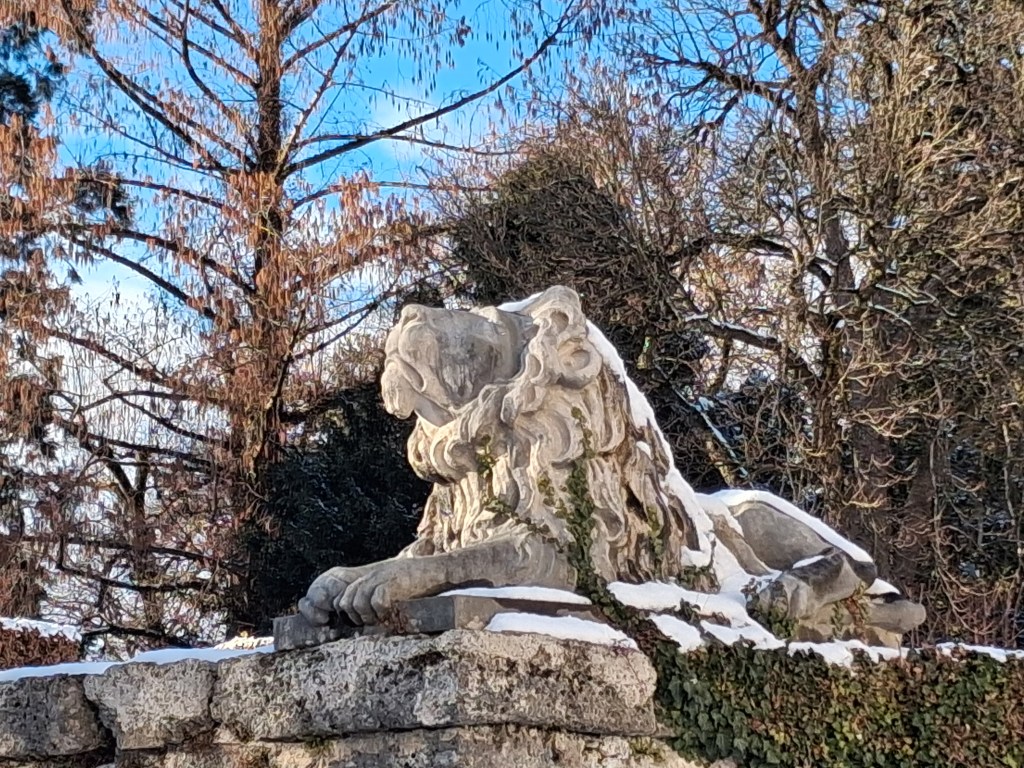
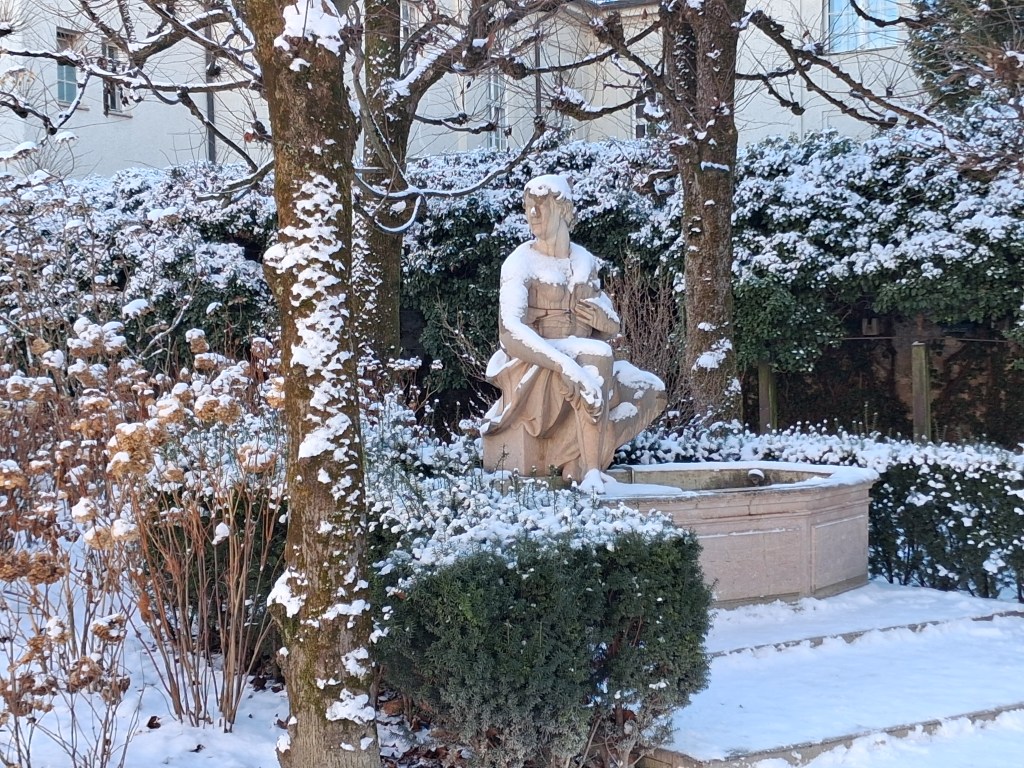

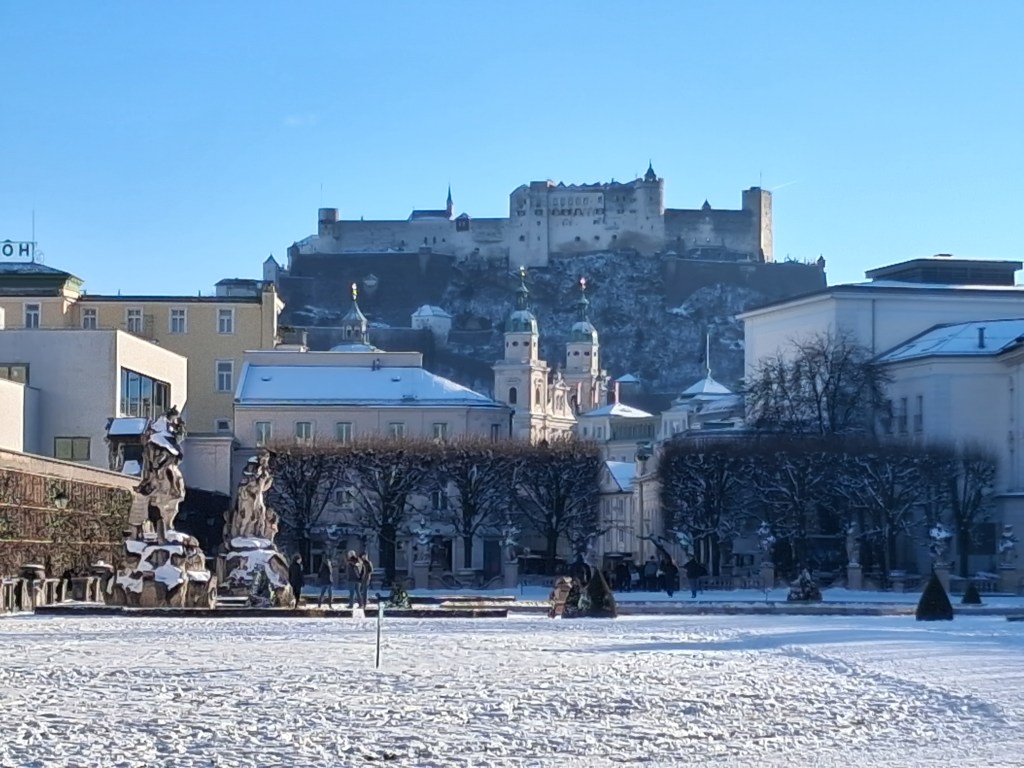
The Gardens are one of the principal settings in The Sound of Music. Specifically, this is where Maria and the children dance around the Pegasus fountain singing Do-Re-Mi and line up on the steps for the finale.
Linzer Gasse is often cited as a nicer street than Getreidegasse – it’s certainly less packed with tourists and has more of a local feel about it…
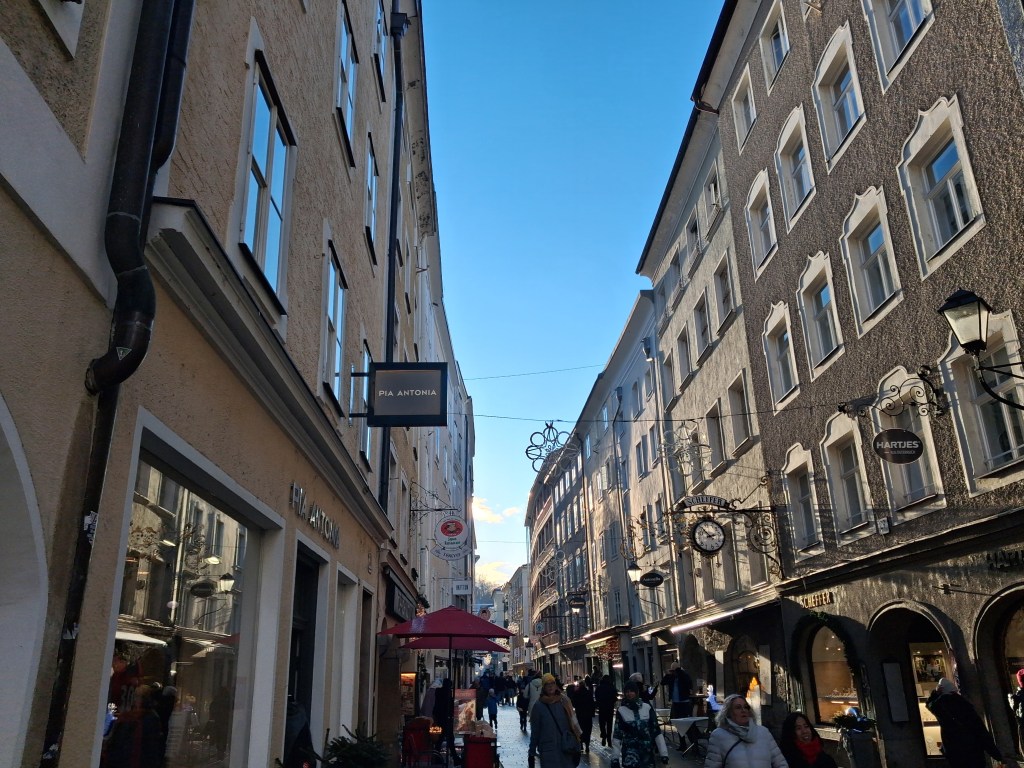


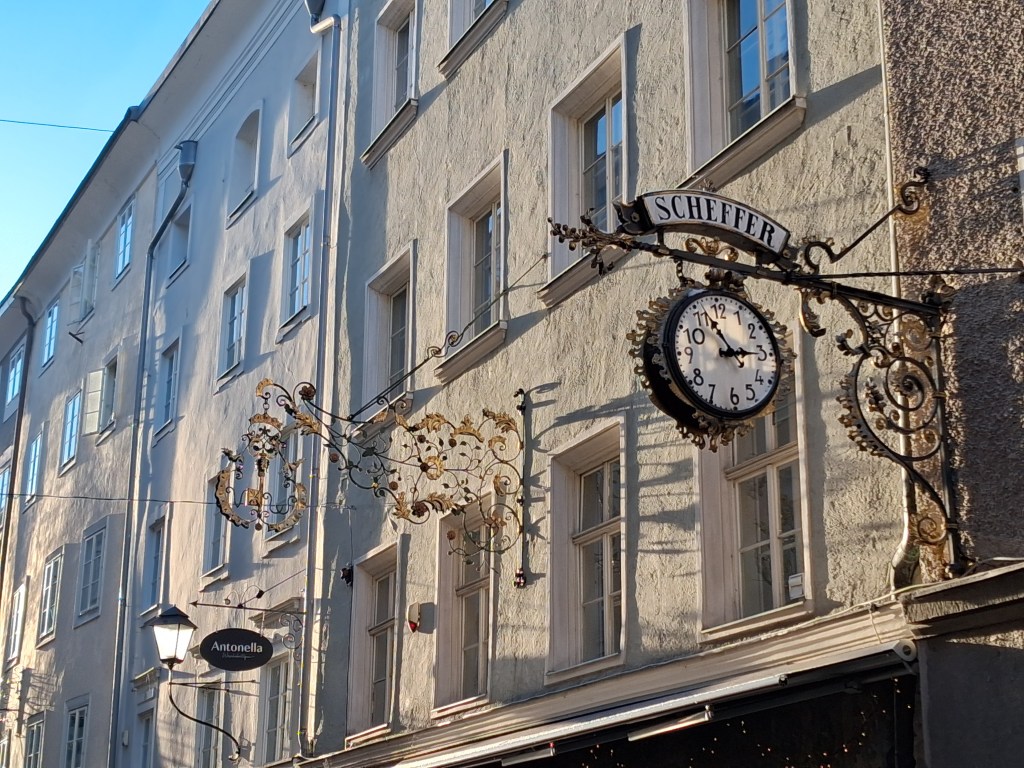

That onion-dome tower up along the street belongs to Sebastianskirche. A devastating fire in 1818 destroyed a lot of the town on this side of the river and the Baroque church didn’t escape – its original ceiling frescos and high altar painting of St Sebastian were lost to the flames.

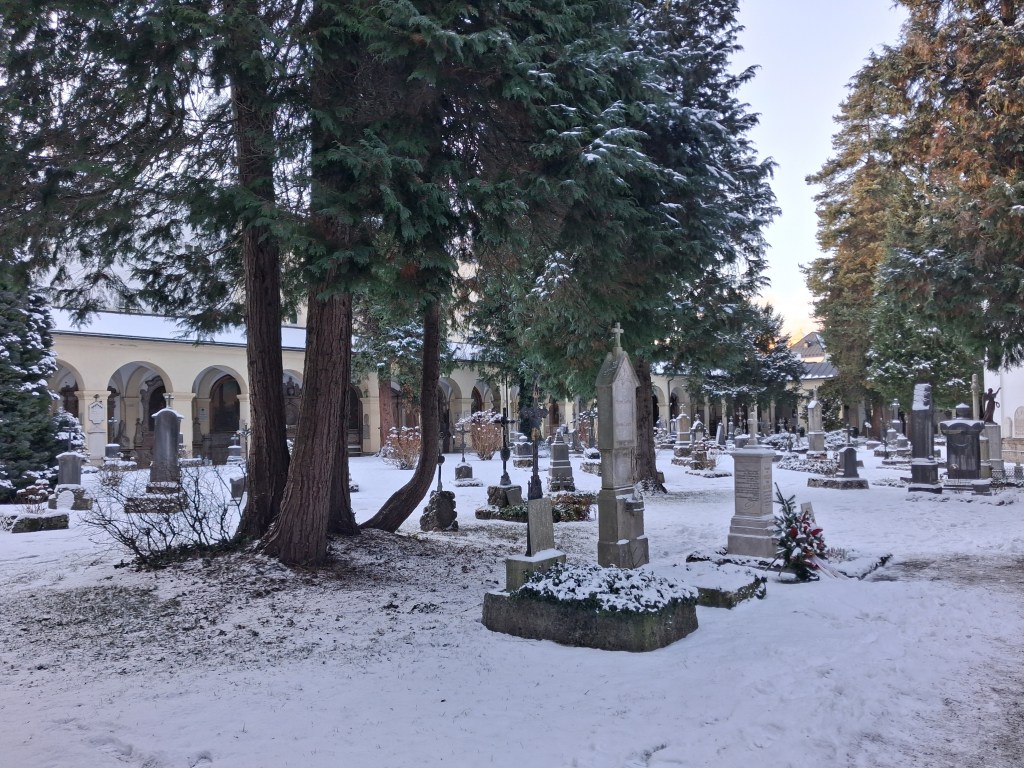
The lovely cemetery behind the church contains the grave of Mozart’s wife Constanze, his father Leopold and other members of the Mozart family (his mother died in Paris and her specific burial site is unknown)

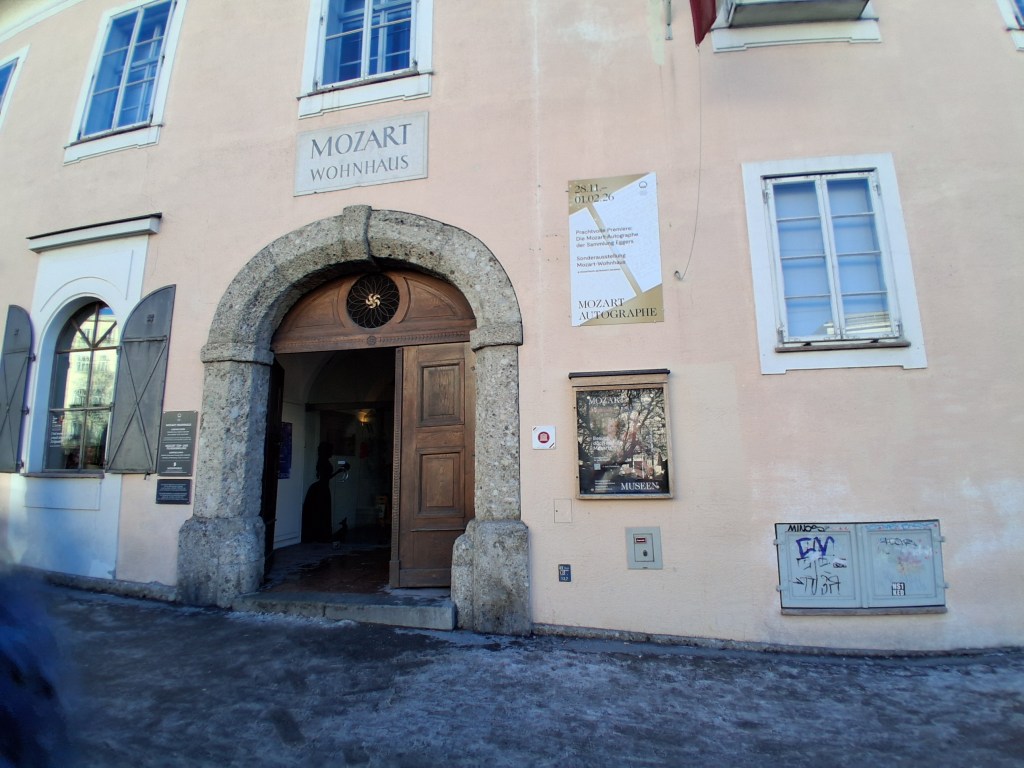
In 1773, the Mozart family moved across the river to an apartment on Makartplatz. While the museum on Getreidegasse focuses on his early life, the museum here at The Residence covers his later family life and features interactive exhibits, manuscripts, etc.
The ancient lane of Steingasse runs pretty much parallel to the river. What was once a major route in and out of the city makes for a lovely alternative walk home. It’s also the birthplace of John Mohr – most famous as the lyricist of Silent Night.
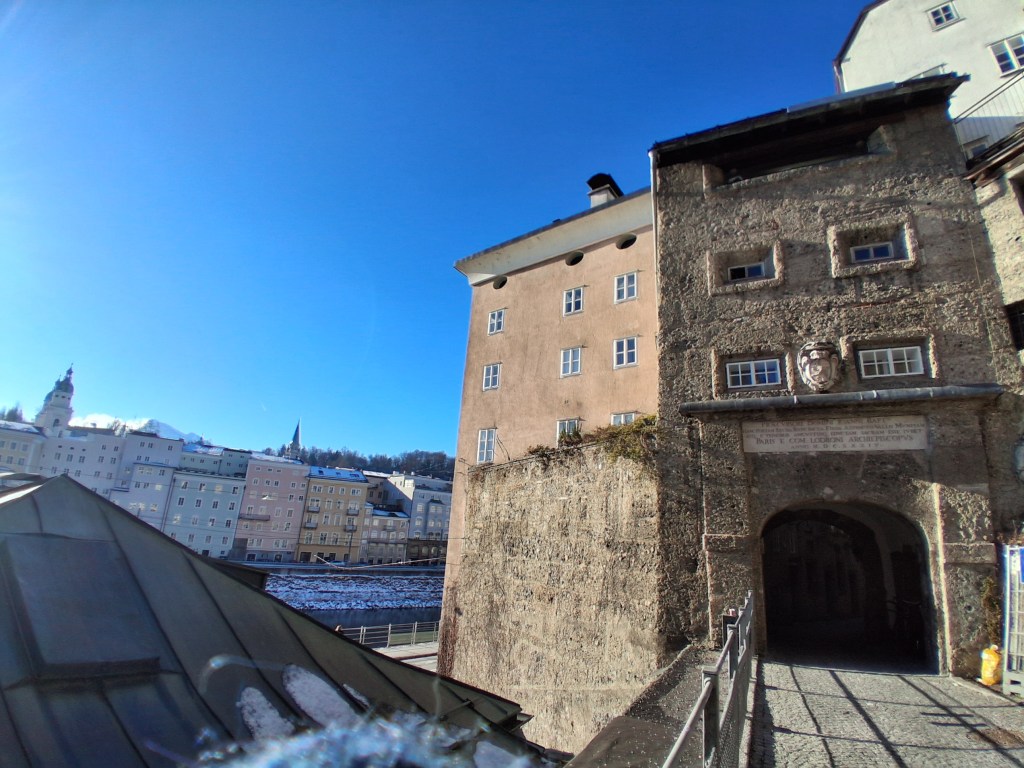
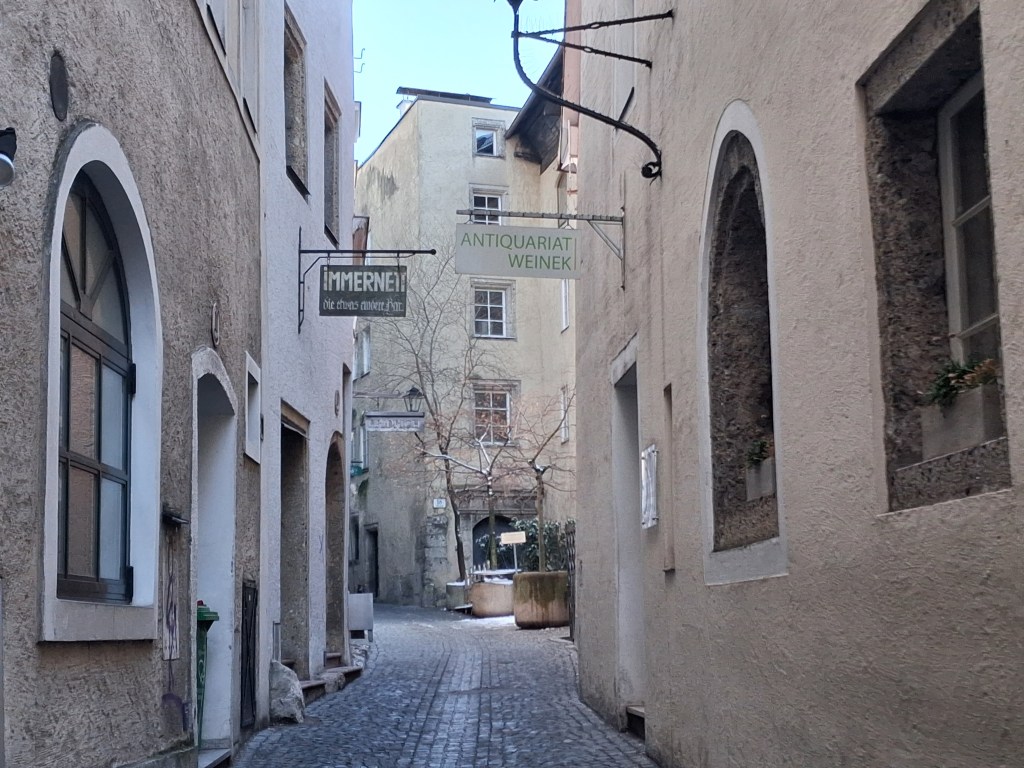
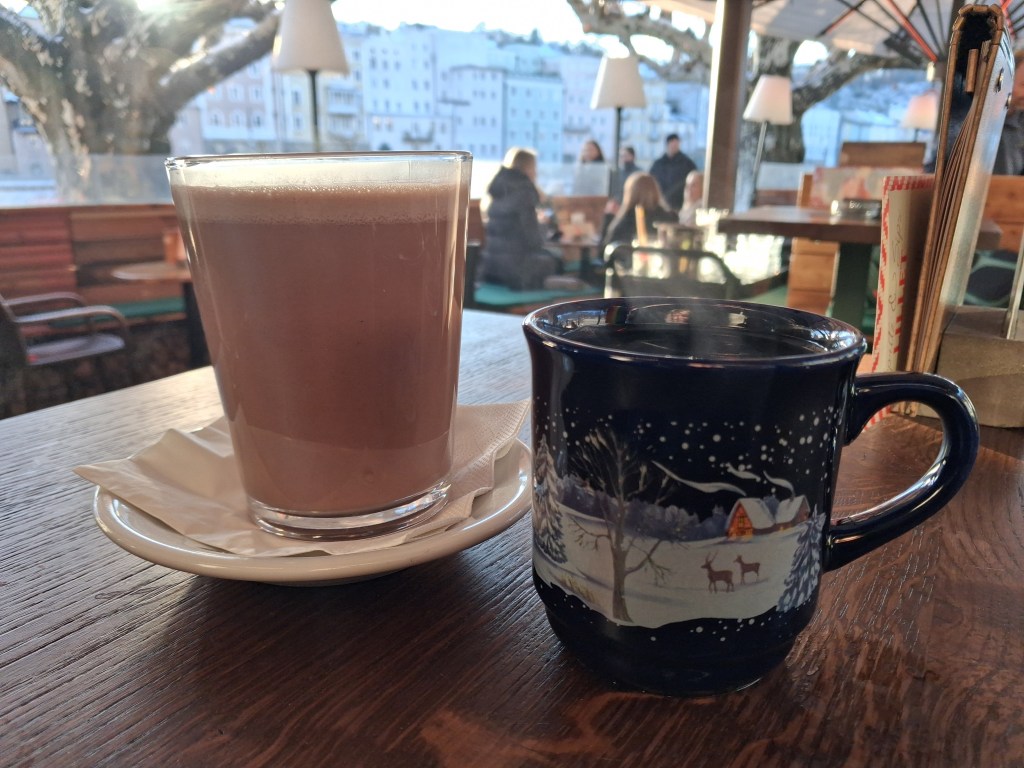
Well – I don’t know about you lot but I’ve seen enough for one day! Time for a well earned gluhwein before heading back to doll up for the evening’s entertainment!
We’d prebooked the BEST OF MOZART FORTRESS DINNER AND CONCERT (€84 each) as a bit of a treat (which was just as well – after such a long day I’d say neither of us would have been bothered to venture out at all!)
Dinner was at 6.00pm – the ticket included the funicular – with a concert at 8.00pm.
Heading towards the funicular…

There were a few different menu options at time of booking – drinks package, etc. We opted for the basic dinner menu.
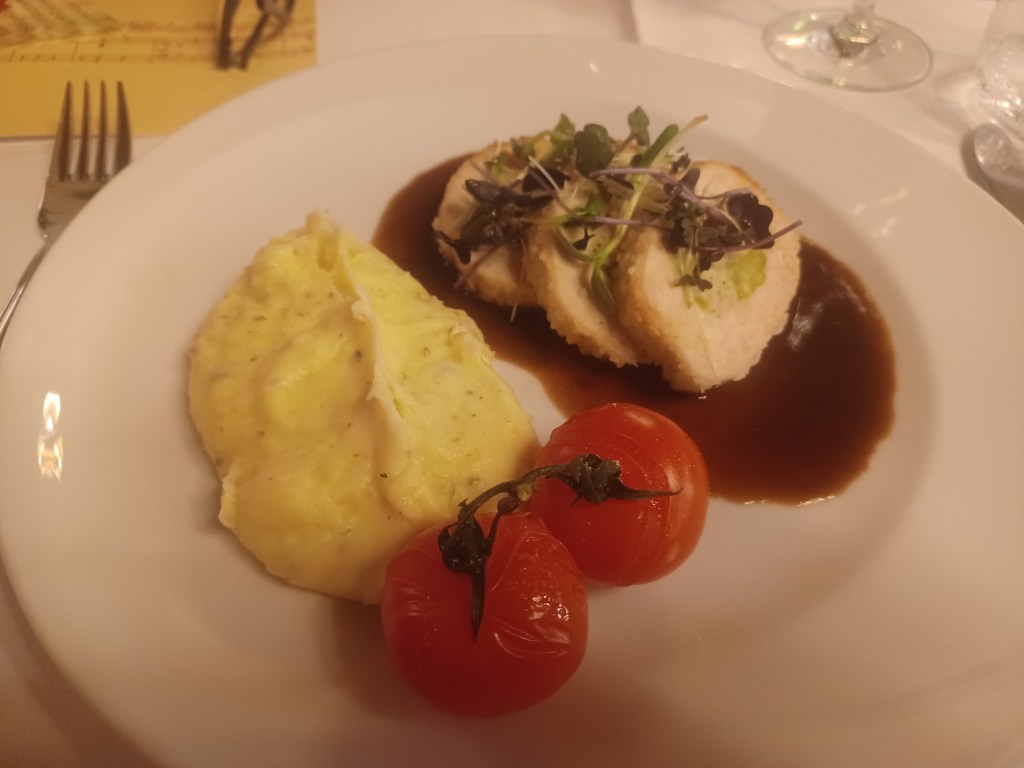
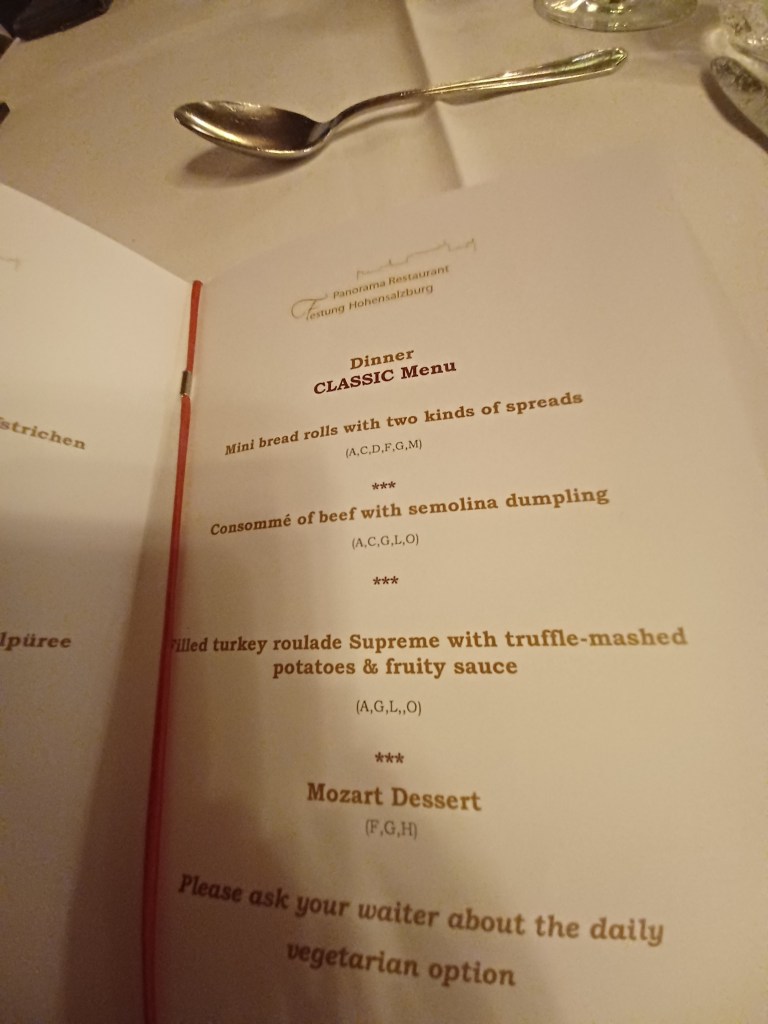
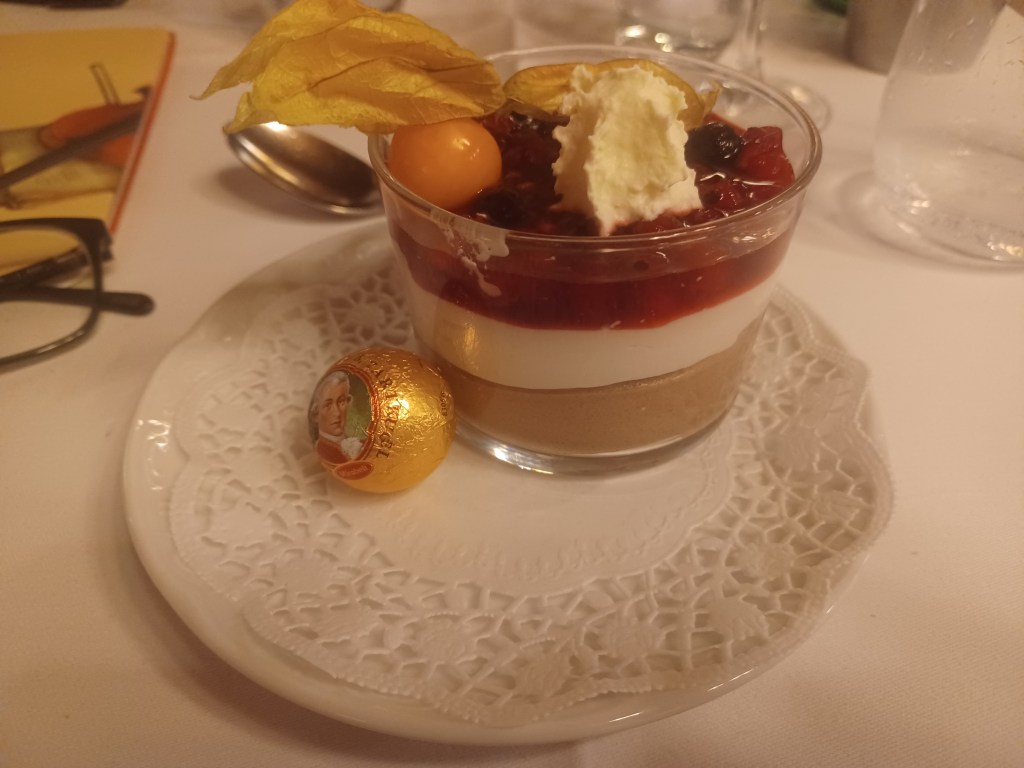
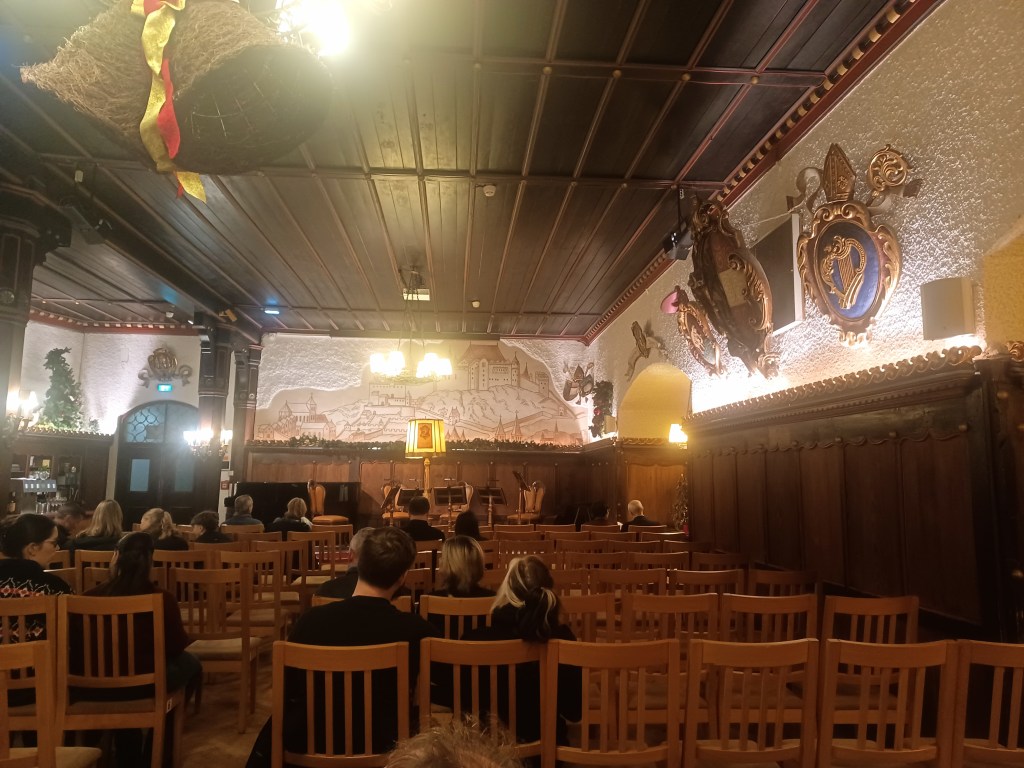
After dinner, a quintet played a selection of pieces from Mozart, Brahms, Strauss, et al….
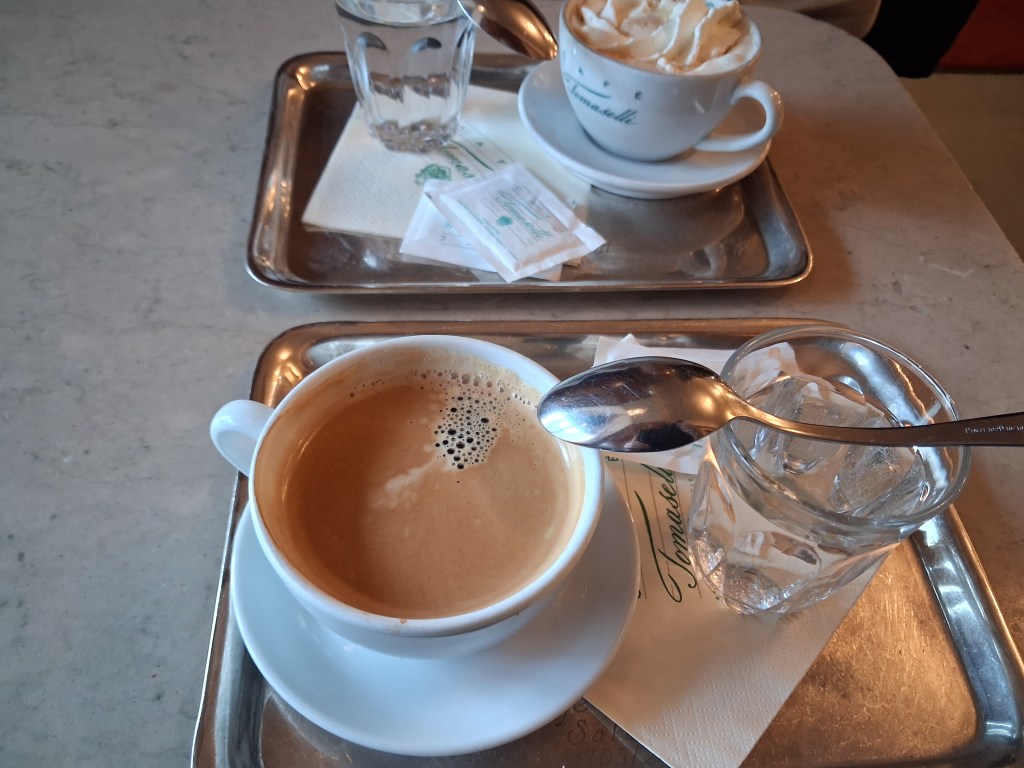
It’s Sunday morning and we eschew breakfast in our hotel for 2 reasons – it’s €25 each (I’m sue it’s fab but €50 is a lot….) and we want to try Tomaselli’s. This famous cafe dates back to 1700 and has been owned by the Tomaselli family since 1852. Of course, ideally, we should visit for coffee and cake but we won’t have time to join the queue later in the morning.
There’s ALWAYS A QUEUE! (taken the previous day!)…..
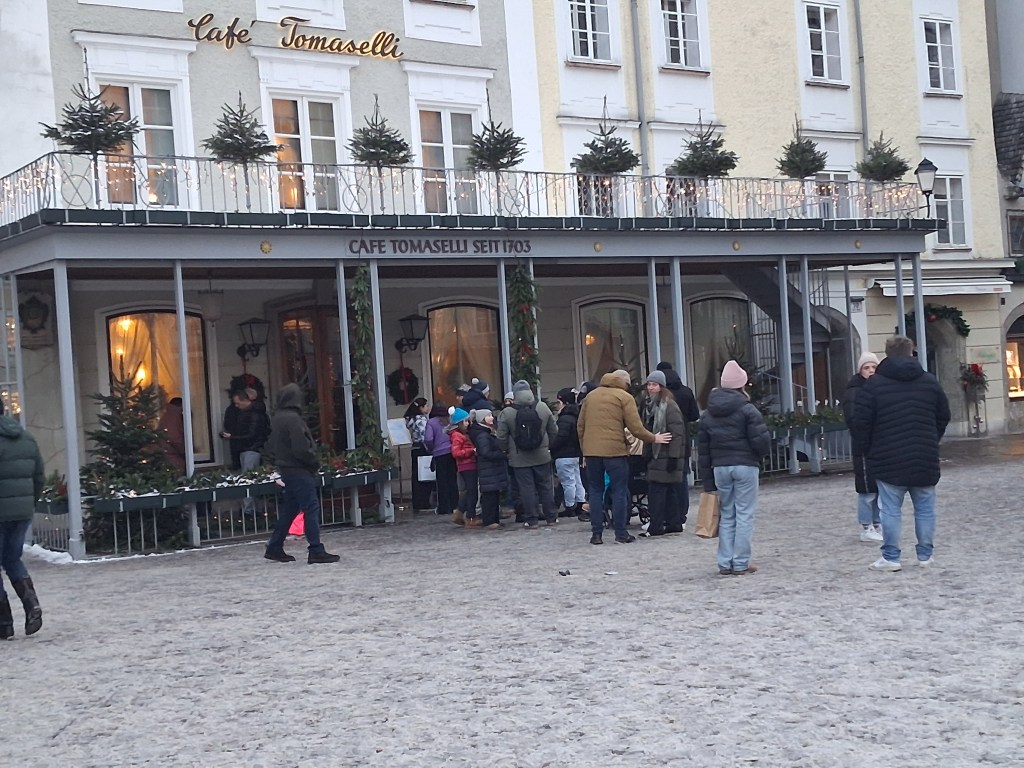
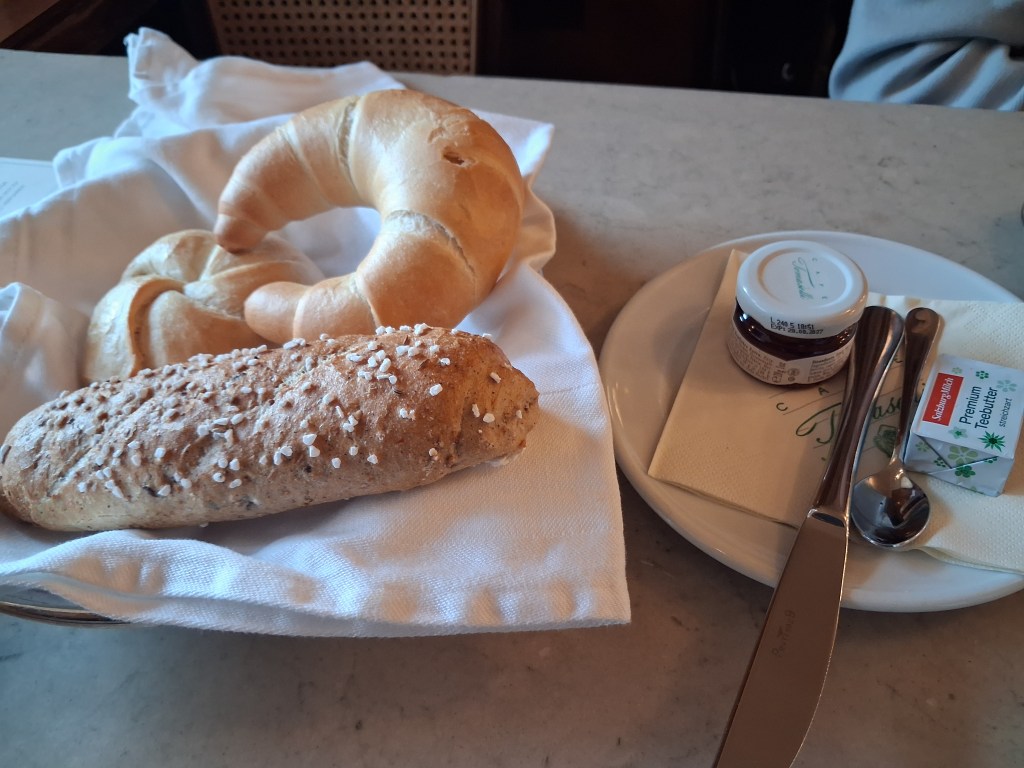
BUT – not on a Sunday at 8.45am!! The room is almost empty when we arrive but there is still a lovely atmosphere and it starts to fill up by 9.15am.

We are very happy with our shared bread basket and omelet….

The cafe is located on Alter Markt – flanked by Baroque burgher houses with the Floriana Fountain in the middle. St Florian, you might like to know, was actually in charge of the Roman firefighting brigade so was an obvious choice as patron saint of firefighters (also chimney sweeps, which ties in a bit, and soapmakers, which I cannot connect at all!!!)
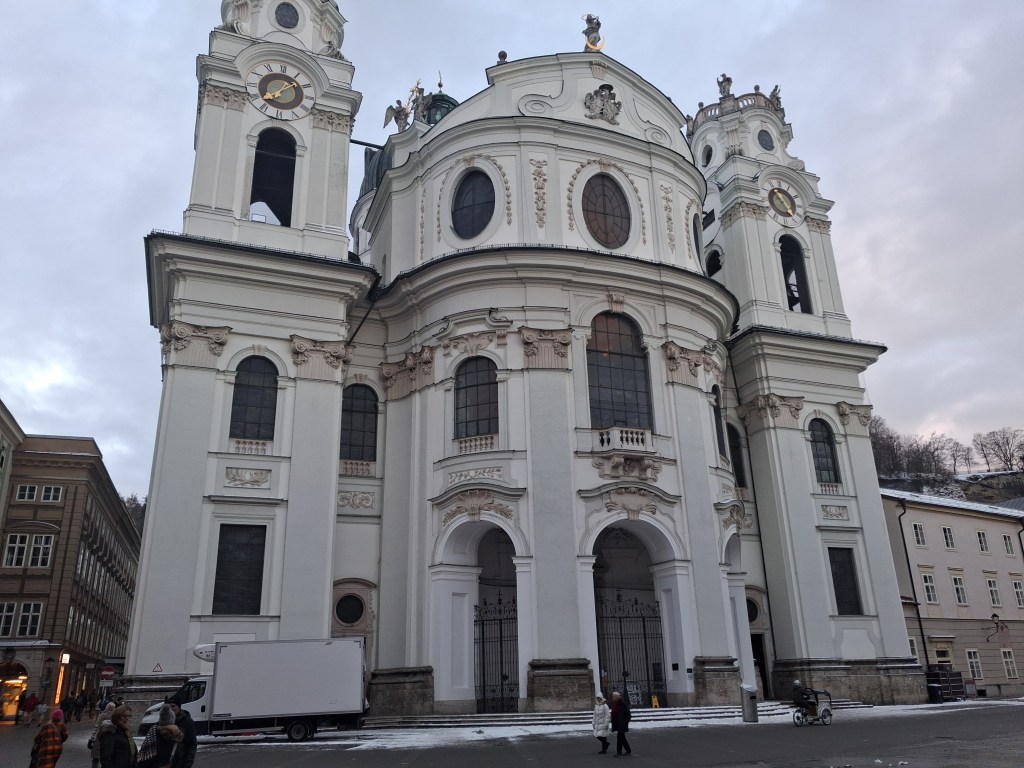
Kollegienkirche was built as part of the Benedictine University, which was founded in 1620. Its subsequent function, however, varied depending on the city’s occupation – it was used as a hay store in Napoleon’s time, it operated as a secondary school under Austro-Hungarian rule and even served as a theatre in 1922! It is once again a place of worship!
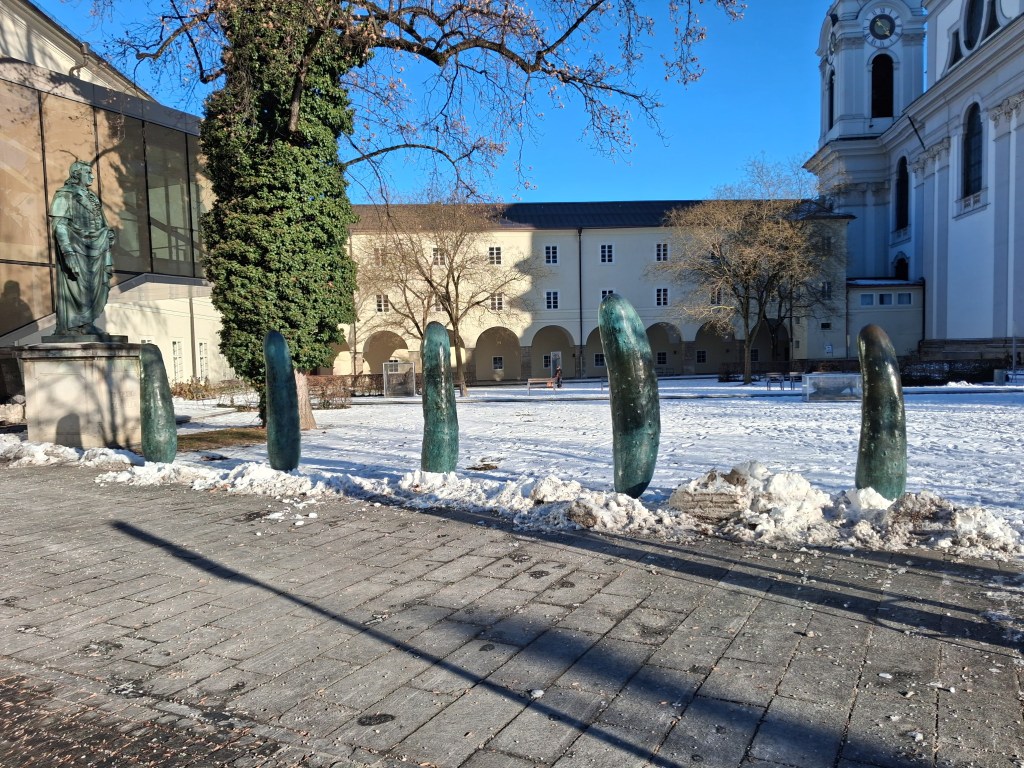
Just around the corner, we come across Gurken (Erwin Wurm) – I love finding such installations amidst the medieval and Baroque buildings.
The Pferdeschwemme is a pretty fancy horse bath! Commissioned in 1693, water came in through underground canals.
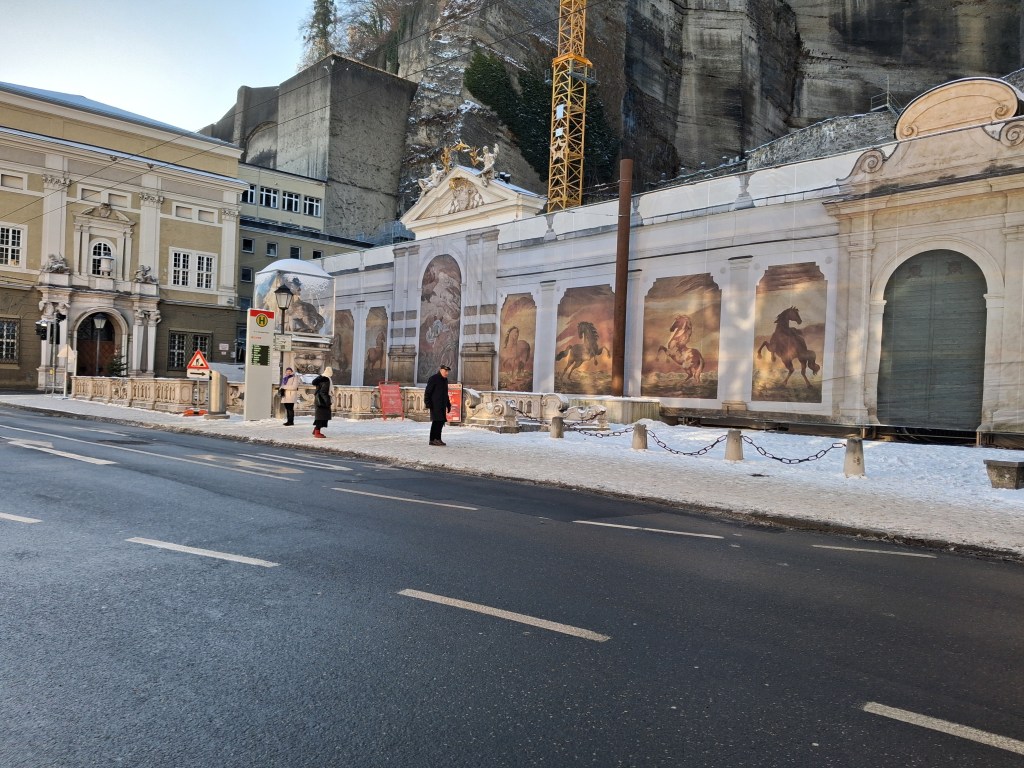
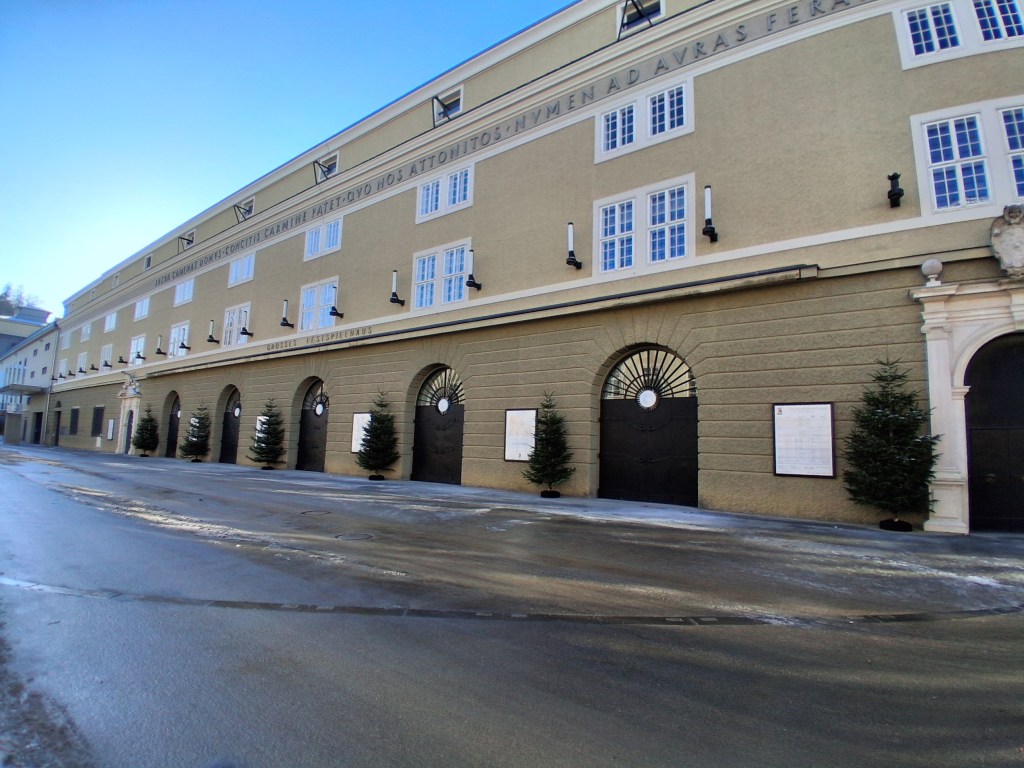
It’s actually close to the court stables where the huge The Grosses Festspielhaus – Festival Hall was built in the 1950’s.
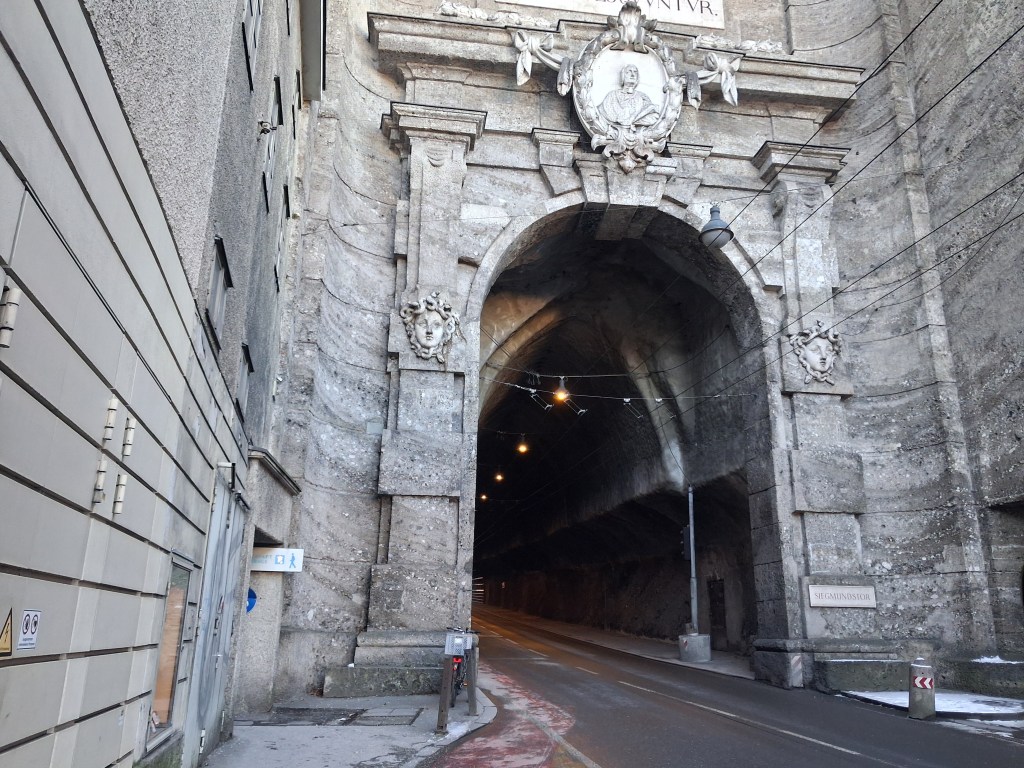
Between the stables and horse bath, the Siegmundstor tunnel was built in the 1760’s, linking the old town with outer suburbs.
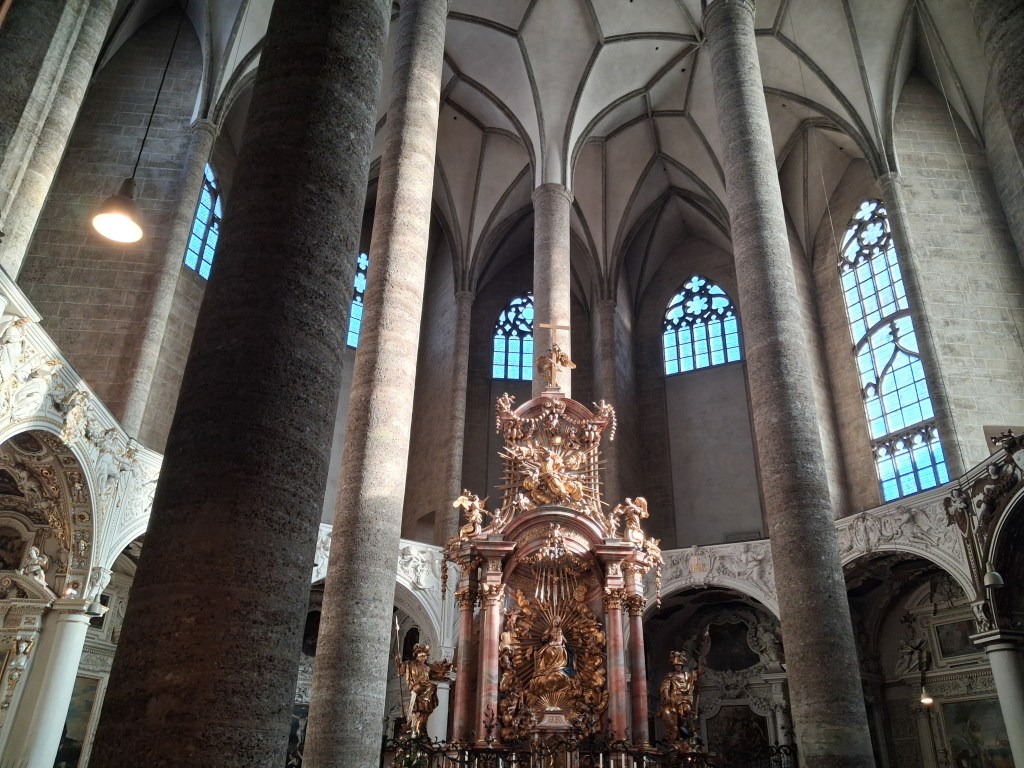
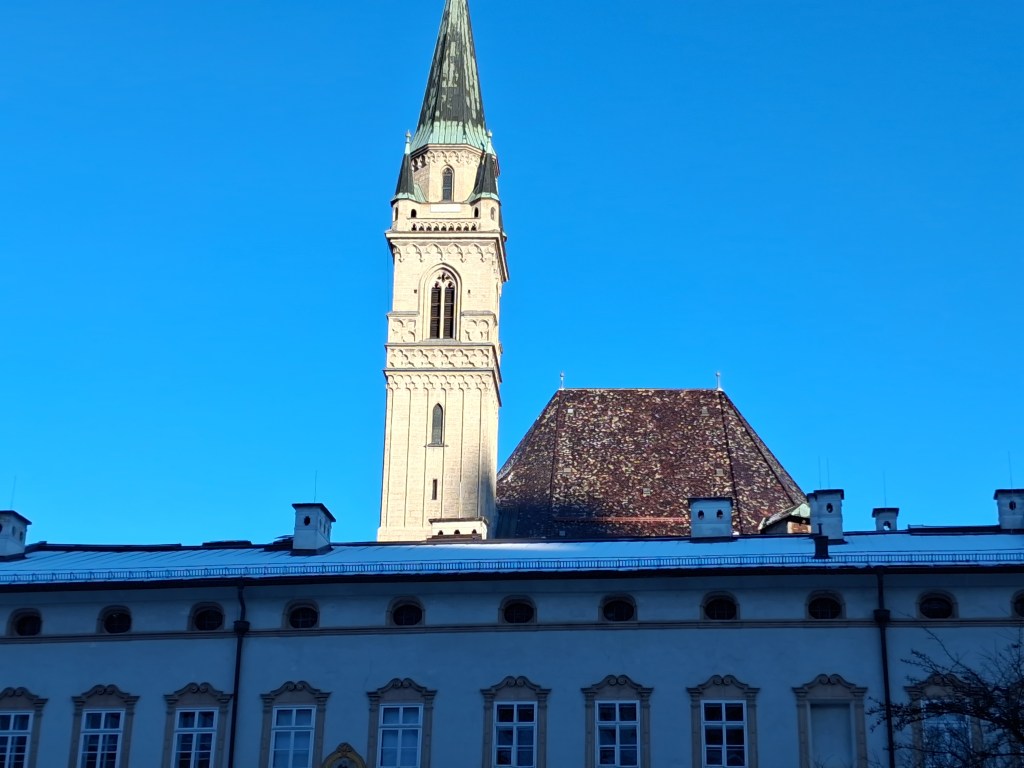
The slender steeple of the Franciscan Church is very much part of the city skyline. The church has long been compared – or contrasted – with the more ornate Cathedral, its Gothic style regarded as more of a place of quiet contemplation.
I suppose it’s fitting that I lopped off the top of the tower in my photo !!! In 1670, the archbishop ordered the top of the spire be removed because it was taller than the cathedral towers! (It was eventually restored in 1866)
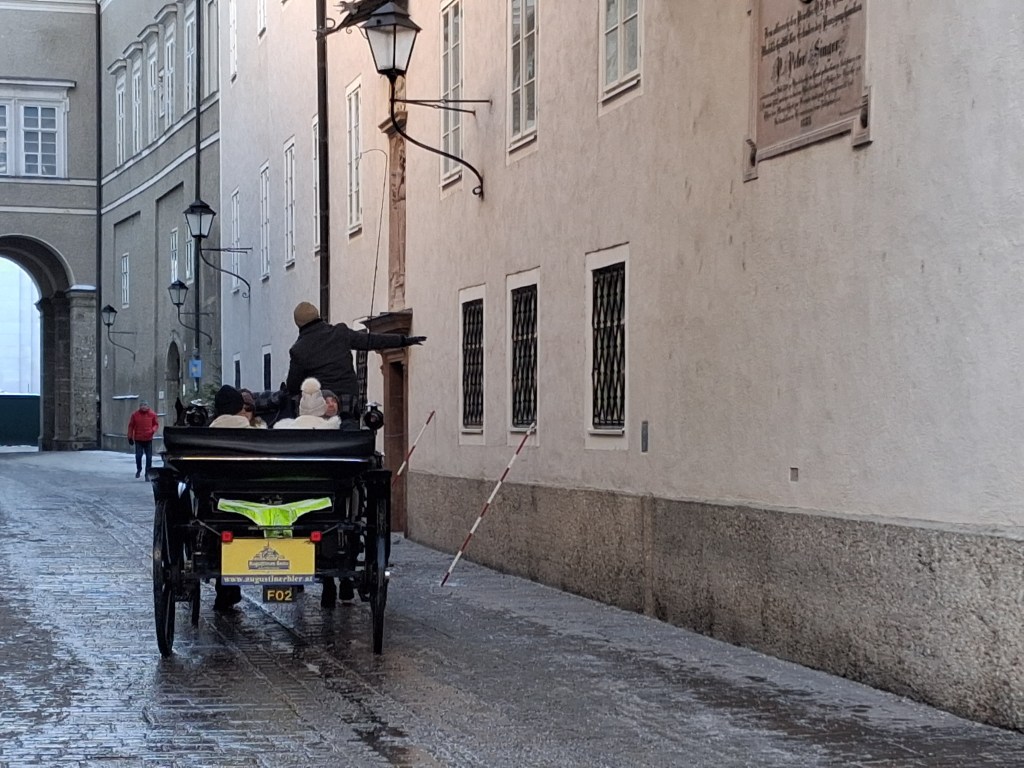
The city centre is surprisingly compact but … if you DO get tired…
St. Peter’s Abbey was founded in the 7th century and is considered the oldest monastery still in existence in the German-speaking world.

St Peter’s Cemetery is even older than the abbey.

This is where the von Trapp family hid before escaping to Switzerland! (The Sound of Music)
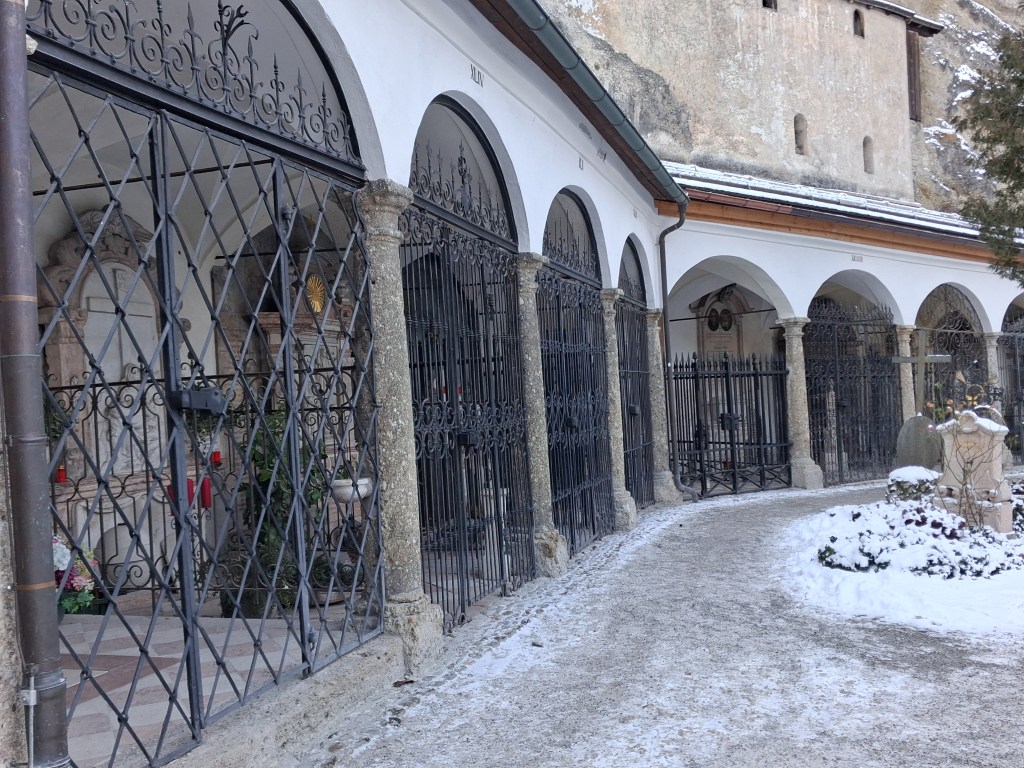
The catacombs, carved into the rock above, served as early Christian meeting places rather than burial sites.
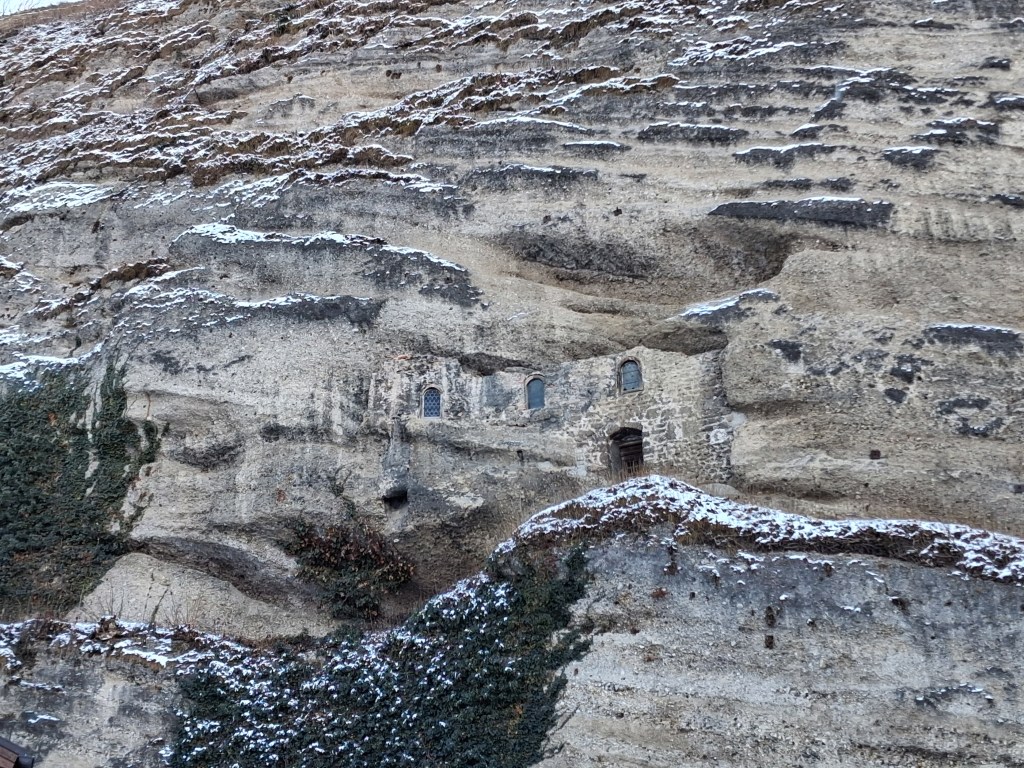
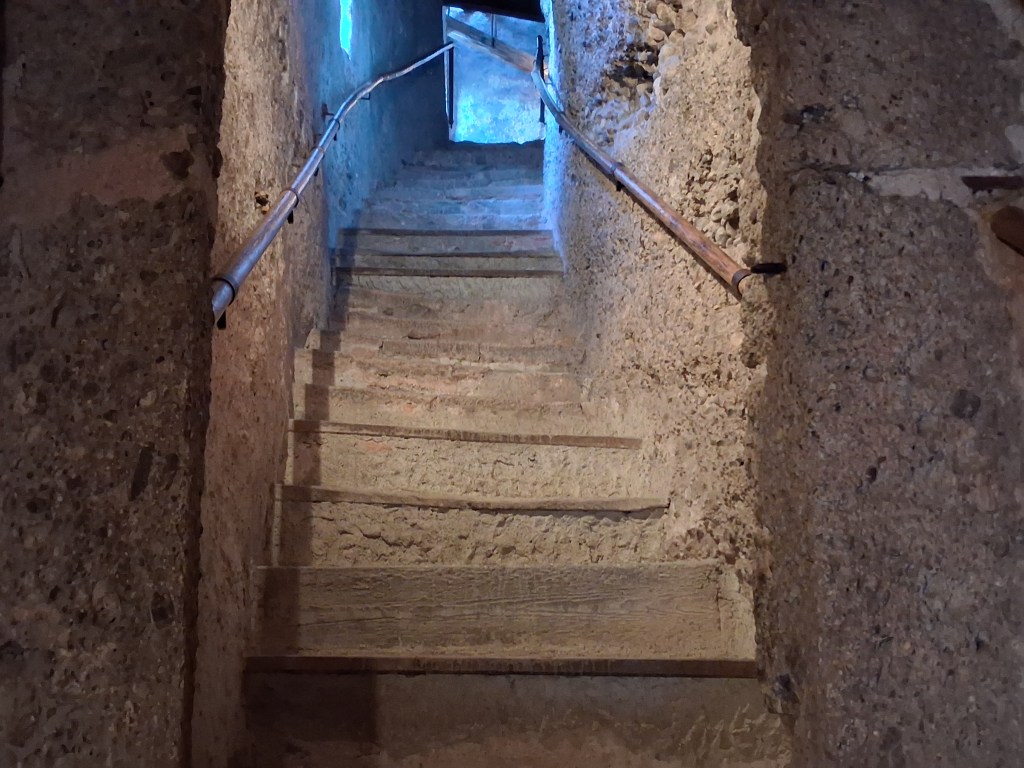
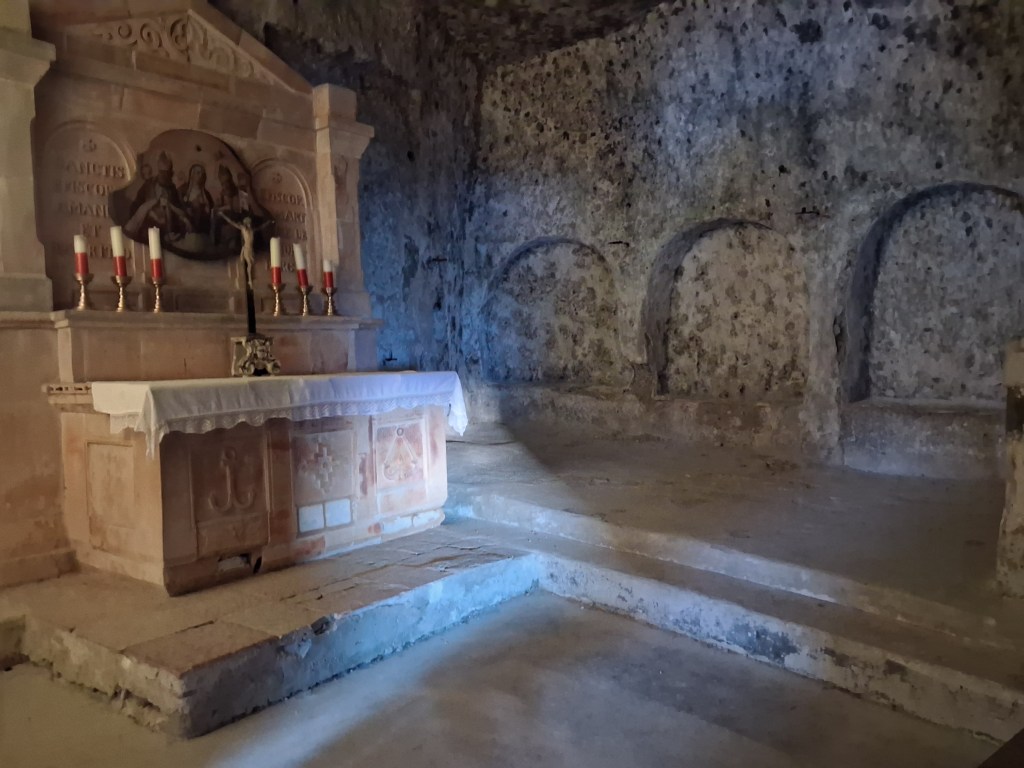
Some levels of catacombs open to the public.

St. Peter’s Bakery is the oldest bakery in Salzburg – they do everything themselves, from milling to the finished product and still bake their bread in a wood-fired oven. It seems to be well worth queuing for but unfortunately doesn’t open on Sundays so we missed out on that treat. We could still admire the traditional mill though!
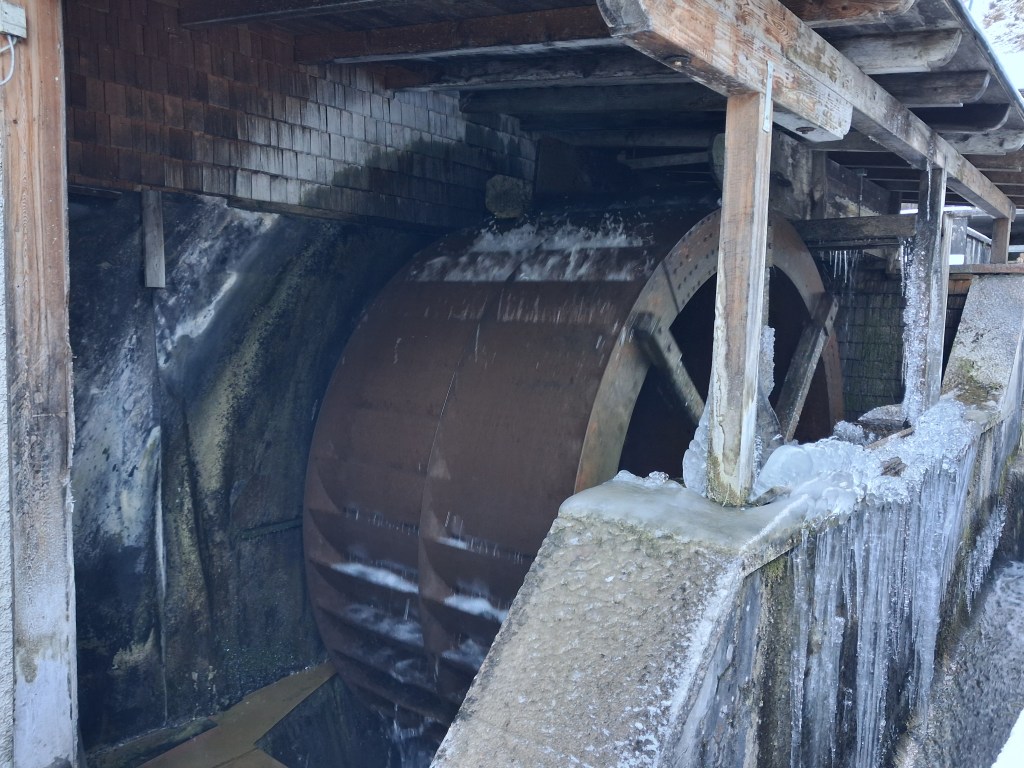
Did I mention it was a tad cold!!!

The buildings around Kapitelplatz – Cathedral, Provost’s Office and Archbishop’s Palace – serve as reminders of the powerful archdiocese that once ruled the city. The fountain – Kapitelschwemme – was built in 1732 as a horse pond Neptune, riding a water-spouting sea horse, is hidden for winter.
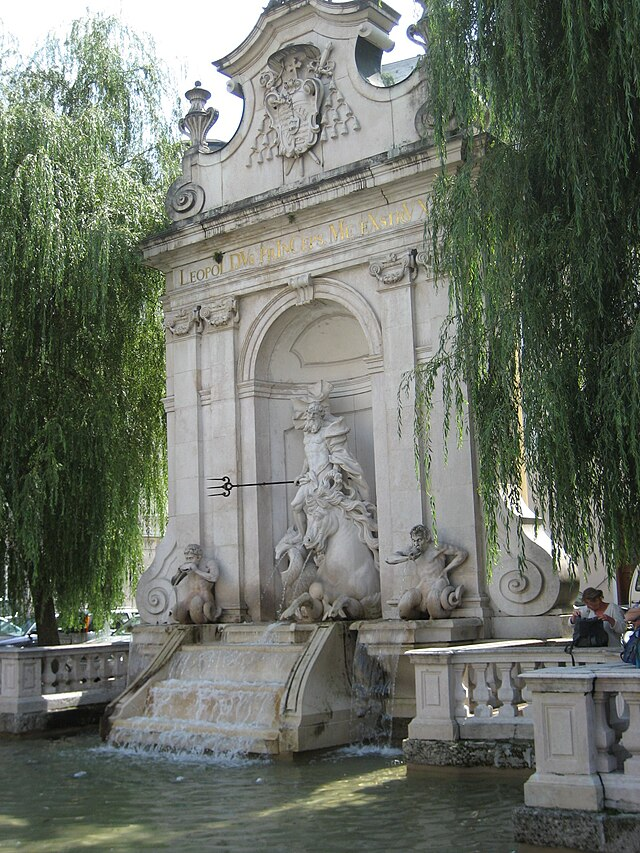
(Courtesy Wikimedia)
And – for something a bit different from the surrounding splendour – Sphaera by German artist Stephan Balkenhol.
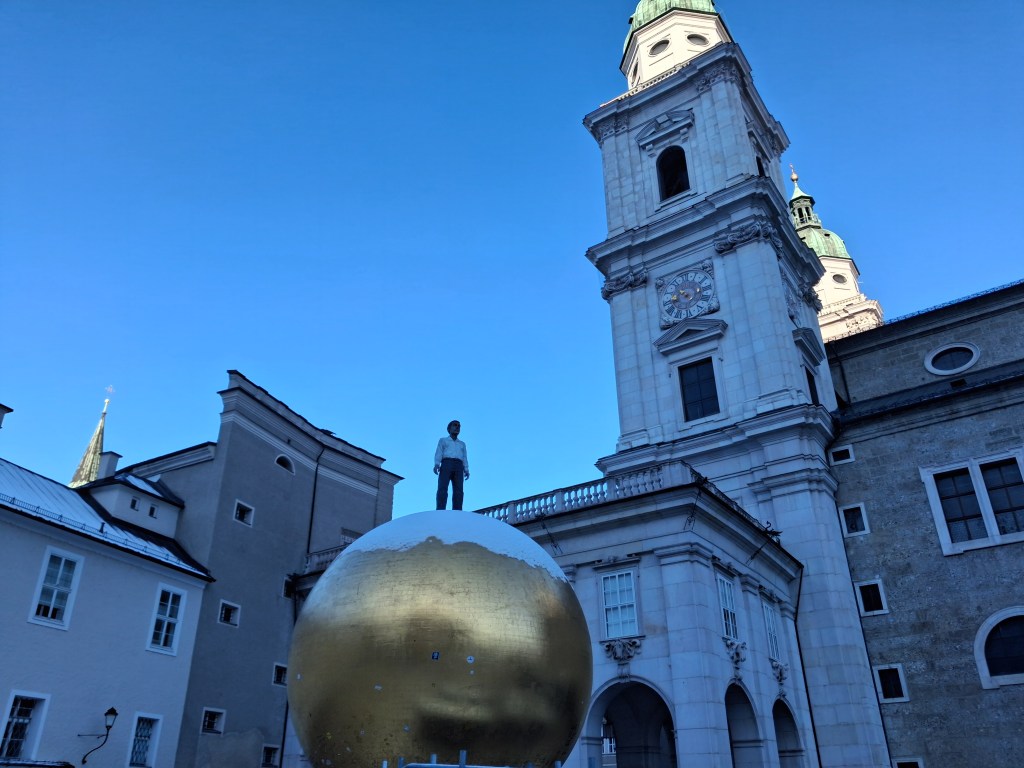
With its white marble facade, fine dome and two towers, the Dom is an impressive landmark indeed. The three numbers above the entrance sum up its history:
In 774 the first Cathedral on the site was built – by an Irishman!
It has been destroyed and reconstructed more than once – a new Gothic masterpiece was consecrated in 1628.
The dome was destroyed by an airstrike in 1944. Following reconstruction, the cathedral was again consecrated in 1959.
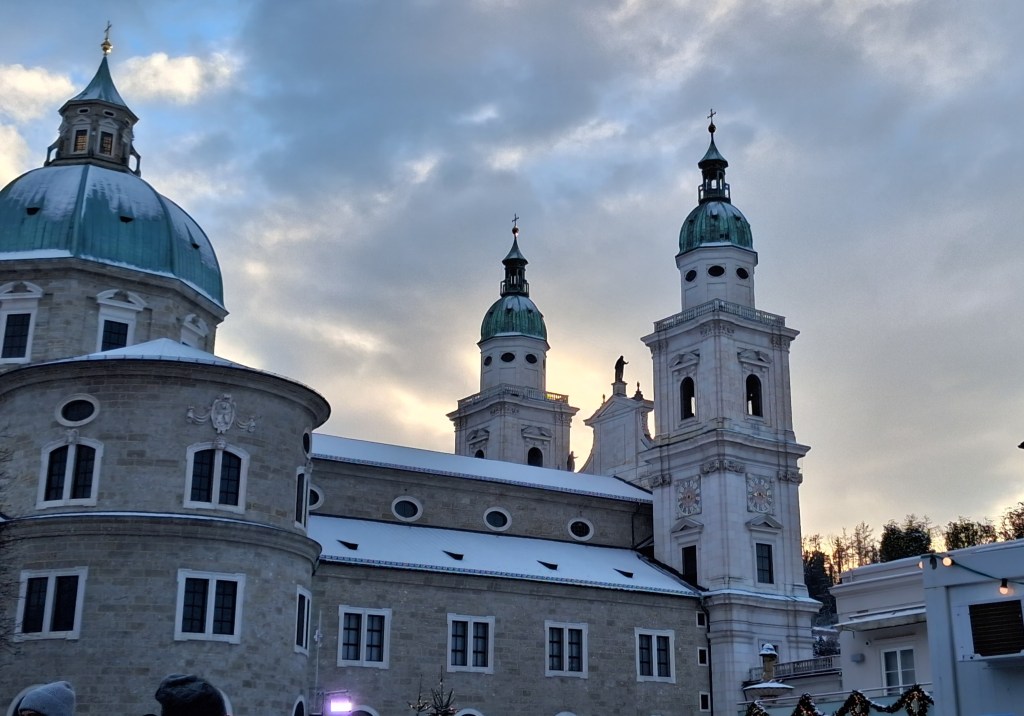
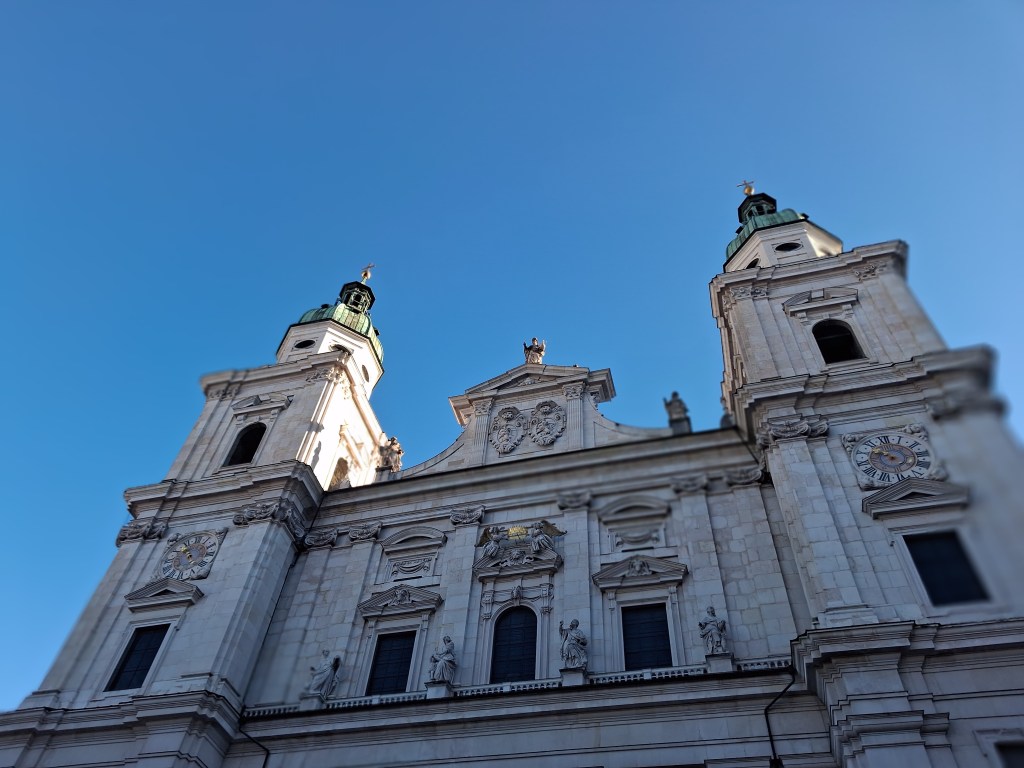

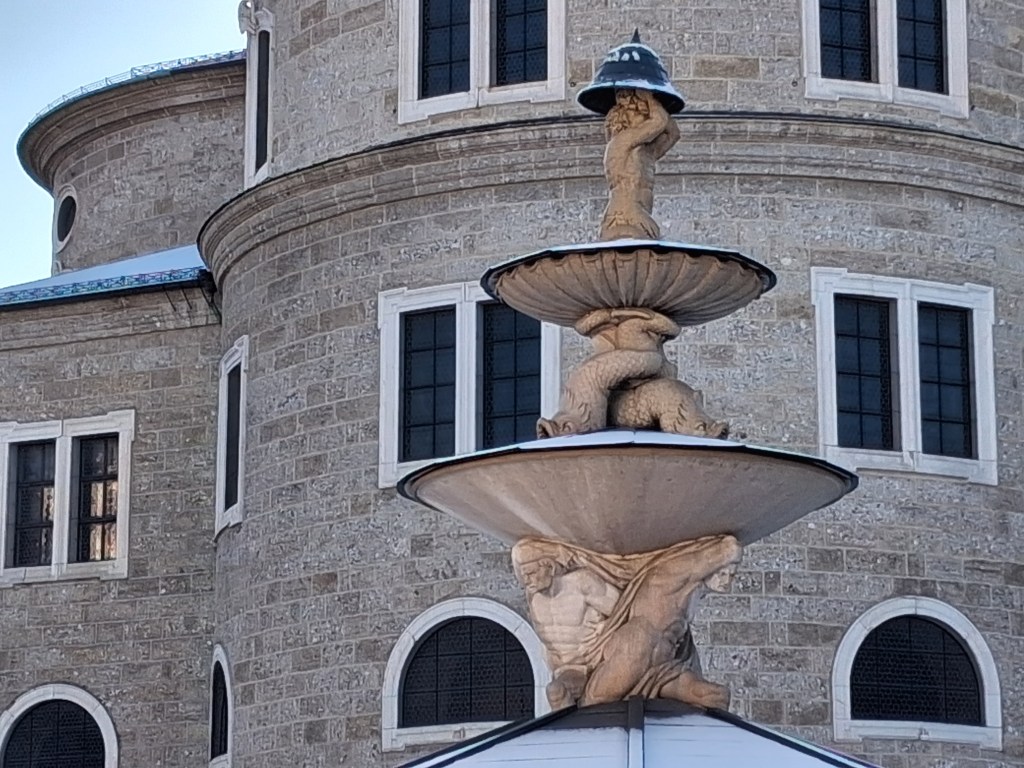
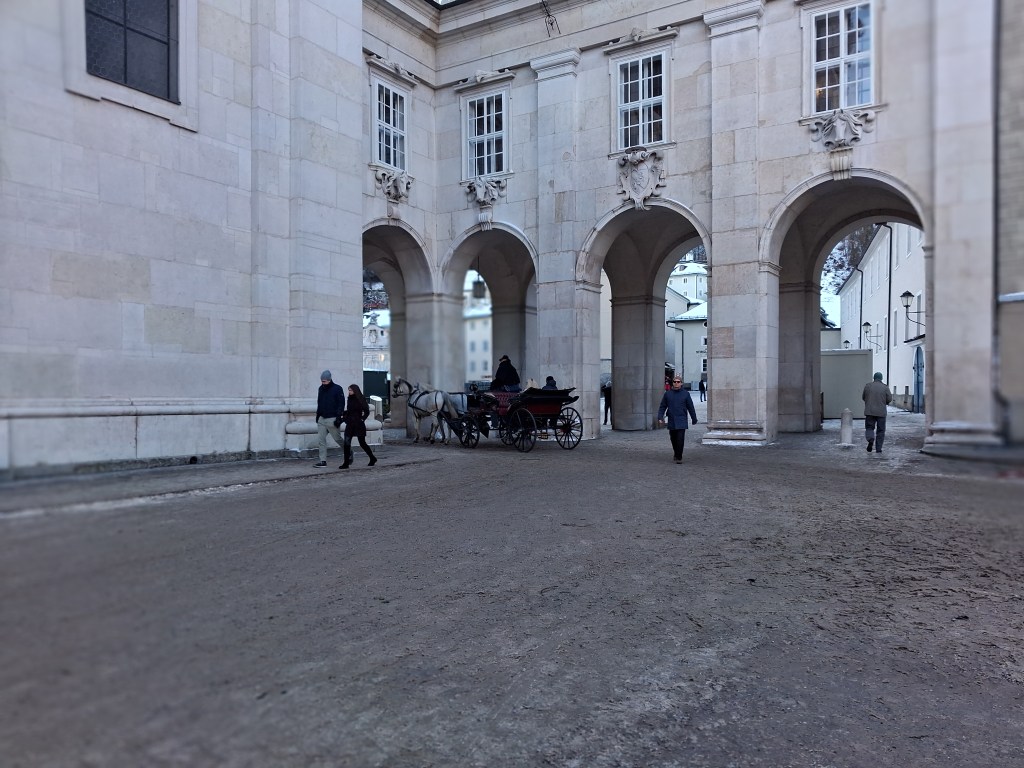
Ah – ego and power! Prince-Archbishop Wolf Dietrich von Raitenau took rule in 1587 at the age of 28. He was well connected – his uncle being Pope Pius IV – and he was greatly impressed by Rome’s emerging Baroque architecture. It is believed to this day that he had the Romanesque Cathedral burnt down in order to redesign it. He built five fine squares in the city centre – the largest being Residenceplatz where he had 55 medieval town houses torn down to facilitate his plan!
PS – this is the same guy who built Mirabell for his mistress and 15 kids!
Most of the lovely fountain is hidden today…

Courtesy, Wikimedia


There HAS to be a Mozartplatz! Time for a selfie and then surely a fitting spot in which to finish our tour!!!
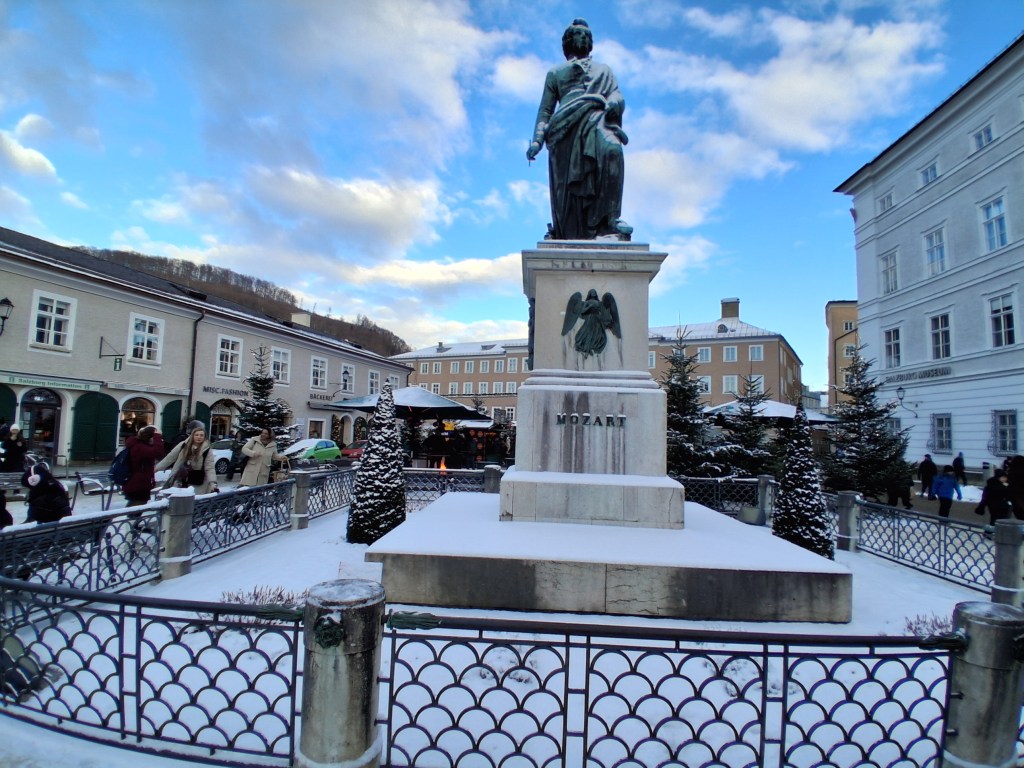

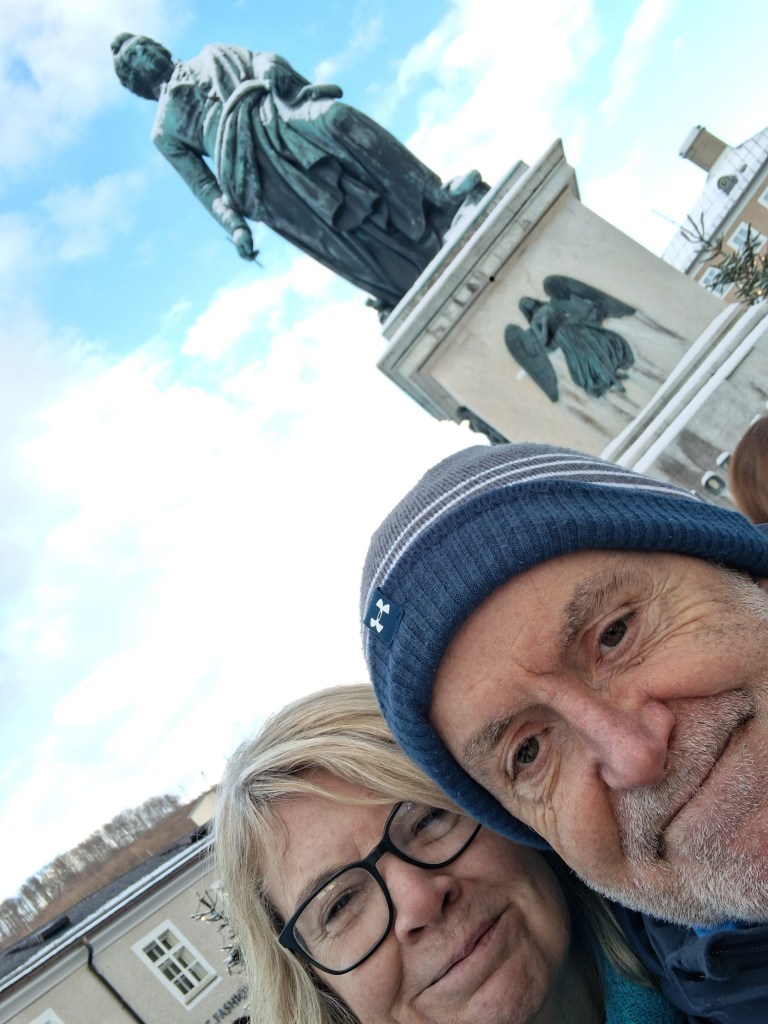
Just enough time for Strudel and Vanilla Custard before we collect the bags and head for the train!!

Small Stuff
*We travelled in early January (2026).
*There was snow on the ground but there hadn’t been a fall in some days. Temperature during the day was circa 0 to -5.
*We stayed at Hotel Elefant just around the corner from Getreidegasse. The location was ideal – close to the airport bus and central to everything. We didn’t dine in so can’t comment on the restaurant but we’d happily stay here again. (€159 – one night / room only).
*Bring Cash – not everywhere accepts cards (we had to pay cash for the strudel in a busy city centre cafe) and the ticket machine at the airport bus stop wasn’t working right but could accept coins.
*Most stores – apart from souvenir outlets – are closed all day Sunday
*With more time …..
We would definitely have visited one of Mozart’s house/ museums.
Followed up on the Walk of Modern Art (remember the Gherkins?)
Climbed up to the walls / towers across river and admired the town from above.
Maybe visited the Fortress in daytime.

Whenever anybody asks for me for travel tips in Europe, particularly along the lines of a beautiful city which isn’t one of the “majors”, it’s always Salzburg which I recommend. I absolutely love it, having been in spring, summer AND, like you, in brass monkey weather, it’s always wonderful. You packed a lot in to 24 hours…but there’s more, so don’t be afraid to return!
I think the direct flight from Dublin might be relatively new so it will certainly make the city more accessible. We’d definitely go again and the train network means it can combine with other cities in the region..
Or a trip out to the Salzkammergut lake region, very highly recommended! Especially the towns around Wolfgangsee, Marie. It’s so lovely there.
Everywhere is just gorgeous isn’t it…..
You did well for your 24 hours in Salzburg, but if -5 is bloody freezing, you better not visit Canada in the winter. 😅 Maggie
Sure Ireland falls apart if it hits +2🤣. We’re a nation of softies!!! We actually hit -15 a few days later so Salzburg was positively balmy compared to the rest of our trip!!!!
What a fabulously planned and executed trip. Pity about your camera. I just went through Kyoto with only a cell phone, so I know that it is a good backup these days. Your photos are lovely.
Well Tom had thankfully changed phone just a few months back – up til then we’d 2 absolute bangers! His phone was actually quite good but I missed holding my camera! I still have to sort it out….
I’ve never been to this part of Austria (only the east of the country) so I thoroughly enjoyed your whistlestop tour! It all looks so pretty in the snow but I think I would opt for milder weather 🙂 Oh, and I was very taken with Gurken AND with the Strudel, naturally!
This was new to us also – it should be a nice base for summer travel I’d say – although warm Strudel and custard works better in winter!!!!
I agree with you, dear Marie, you can absolutely see a significant amount of a city in a single day by prioritising, planning, and using efficient transport, if needed. A well-planned 7-9 hour itinerary allows you to cover major landmarks, enjoy local cuisine, and experience the city’s atmosphere. The last time I was in Salzburg was in the middle of summer when the flowers were in full bloom. It looks equally beautiful covered in snow and most certainly offers the perfect backdrop for an unforgettable city break in winter. Thanks for sharing, and have a good day 🙂 Aiva axx
Beautiful as it is in the snow, it certainly sounds like we’ll have to go back in good weather!
I was there in May on a day trip from Vienna. With a city pass, I visited pretty much the same places as you, feeling like I was rushing from one sight to the next without really enjoying them. A few days would have been better, but there is also so much to do in Vienna.
That would be quite a long day for you – because it must be a few hours between the cities before you fit in any sightseeing at all…
We also had about 24 hours in Salzburg and saw a lot but not enough! We visited in August I had a lot of fun recreating some of the scenes from the Sound of Music.
I can just picture you Lissy – on those steps!!!!!
I love Salzburg and your post is bringing back fond memories for when we visited a few years ago. My mouth is now watering and I’m craving some strudle. The city looks charming in the winter with all that snow.
All those central European towns and villages are so pretty anyway but the snow – and Christmas decorations – really turn them into magical places.
It’s so beautiful in the snow; I love Salzburg and always enjoy visiting – particularly for the strudel. It has a lot to see and do, as your post showcases well 🙂
Do you combine it with other places Hannah or just visit it on its own?
I’ve done both – ive combined it with hiking and history in Eagles Nest…and once combined with Munich…and then Ive been on its own for a long weekend 😊 its a perfect little getaway!
Eagle’s nest sounds like a good day trip from the city….
Very impressive how much you were able to see and do in 24 hours, thanks to your advanced planning and the freezing weather! Appreciated the historical background you shared, as I wasn’t aware of it, even though we visited the city several years ago.
We really had to keep on the move – because night set in so early. I had my tick list and luckily we weren’t particularly into their shops so that didn’t distract!
Brought back some great memories!
Ah that’s good! I’m actually amazed at how many people know the city – I don’t know why…. maybe it’s because it took me so long to get there that I assumed no one visited it either!!!!!