
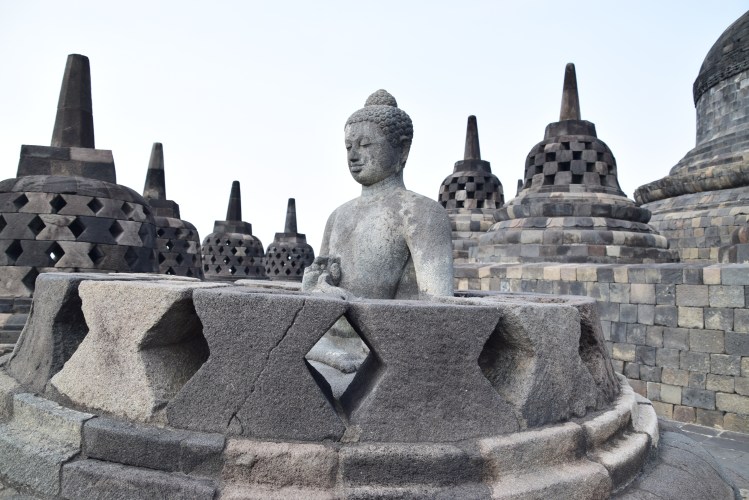
Cast your mind back some 1200 years to the golden age of the Shailendra dynasty – a ruling family holding sway over Java and Sumatra. The region is still dominated by Hinduism but the clan adhere to Mahayana Buddhism and build many temples and monuments under its rule, establishing Java as a centre of Buddhist worship and scholarship.
And the crowning glory is the magnificent Temple of Borobudur.
Neither manpower nor money is a problem in such a massive undertaking – Java supports a huge population and is immensely wealthy, thanks to its rich volcanic soil and even more so to its location as a key post in international trade. Two million stones are carted from local rivers and streams and fitted tightly together around a natural hill – without mortar – to create a 95-foot-high step pyramid. It is built in three tiers above a base – five square terraces, topped with three circular platforms, topped by a central dome.
The entire structure contains 504 statues of Buddha! The lower terraces are decorated with almost 3000 bas-relief sculptures, illustrating the life and teachings of the Buddha. Around the circular platforms are 72 openwork stupas, each containing a statue of the Buddha. Together they make up the greatest collection of such Buddhist sculpture in the world.

Aerial View, 2006, (courtesy Wikimedia)
The structure is divided into three vertical levels that mirror the stages of Buddhist spiritual progress.
The universe is divided into three superimposing spheres – kamadhatu (where we are bound to our desires), rapadhatu (we abandon our desires but are still bound to name and form) and arupadhatu where there is no longer either name or form).
Down in the hidden base of the temple – which almost nobody sees – are some 160 panels illustrating earthly desires and all the troubles and shortcomings of ordinary life – kamadhatu.
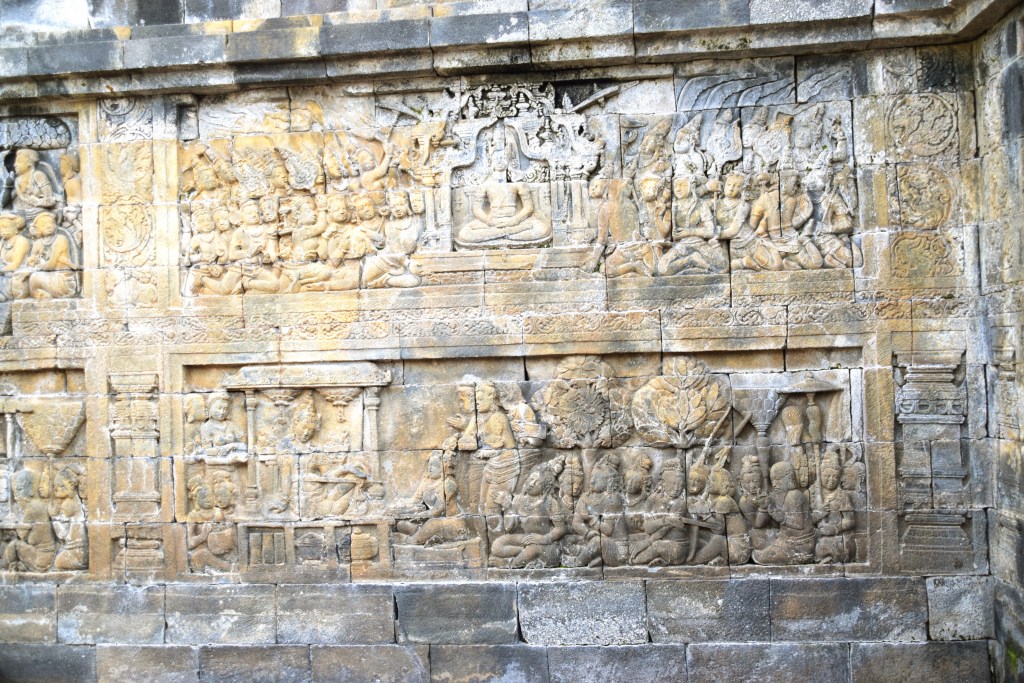
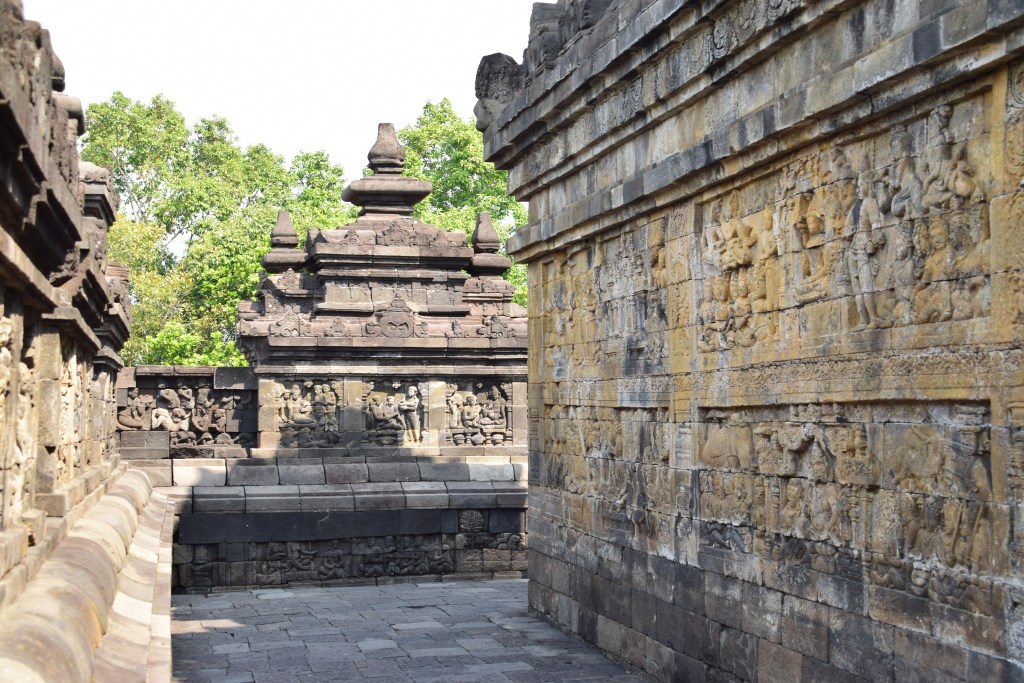
The five square terraces make up rapadhatu. Here, the panels illustrate the the life – and past lives – of Buddha. Other panels tell stories of good deeds done by others.



The walls of the upper circular tiers are bare and simple. Openwork lattice stupas containing seated Buddhas, representing freedom from earthly attachments – arupadhatu


At the very summit sits a huge bell-shaped stupa. Inside it? Nothing – the void – the ultimate goal of this spiritual journey. Nirvana

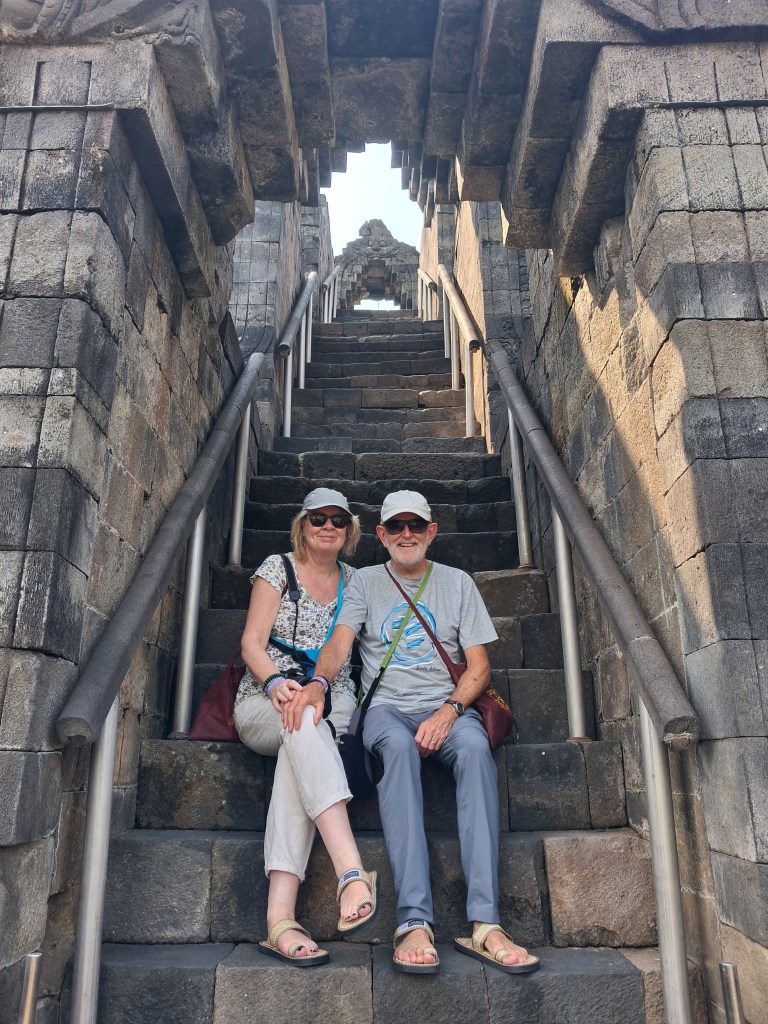
Pilgrims begin at the eastern stairway and walk clockwise (pradakshina), through a system of stairways and passages, up through the nine levels – physically enacting the spiritual climb – covering over 5kms before reaching the summit and enlightenment.
The magnificent site drew pilgrims for hundreds of years. The exact reasons for the temple’s decline are unclear, but, by the 1500s, the centre of Java life was shifting away from the region to elsewhere on the island. This period also marks the arrival of Islam to Java. Bodobudur was abandoned – buried under a deposit of ash from nearby Merapi Volcano and overgrown with lush vegetation. In the end, it was only the local villagers who passed on the story of something large lying under the mound….

Borobudur remained hidden for centuries – until 1814 to be precise! The British captured the island during the Napoleonic Wars (1803-1815) and the newly appointed lieutenant governor – Sir Thomas Stamford Raffles (yep – he of Raffles Hotel and the Singapore Sling!) heard reports of a ‘hill of statues’ hidden deep in the island’s interior and ordered a team to investigate. Following the excitement of the ‘rediscovery’, Raffles sent a Dutch engineer and some 200 men who spent two months clearing the site until the shape of the terraces emerged. By 1835, the temple was totally unearthed.
Yes – the wonders of Borobudur were again revealed – but at a cost. Once more, the building was exposed to monsoon rains, but this time, the original drainage system no longer functioned and the foundations had shifted, causing the structure to deform. Local villagers helped themselves to stone for construction while international visitors removed Buddha heads and other souvenirs for their museums and private collections.
By the early 1900s the terraces were visibly out of alignment , the reliefs were eroding and intervention was badly needed. The first ‘reconstruction’ – 1907 to 1911, under Dutch archaeologists – was really more of a rescue mission. The monument was stabilised and the carvings cleaned but the underlying problem – water still seeping through the internal stone, causing leaks, salt deposits and stone flaking – was not solved.

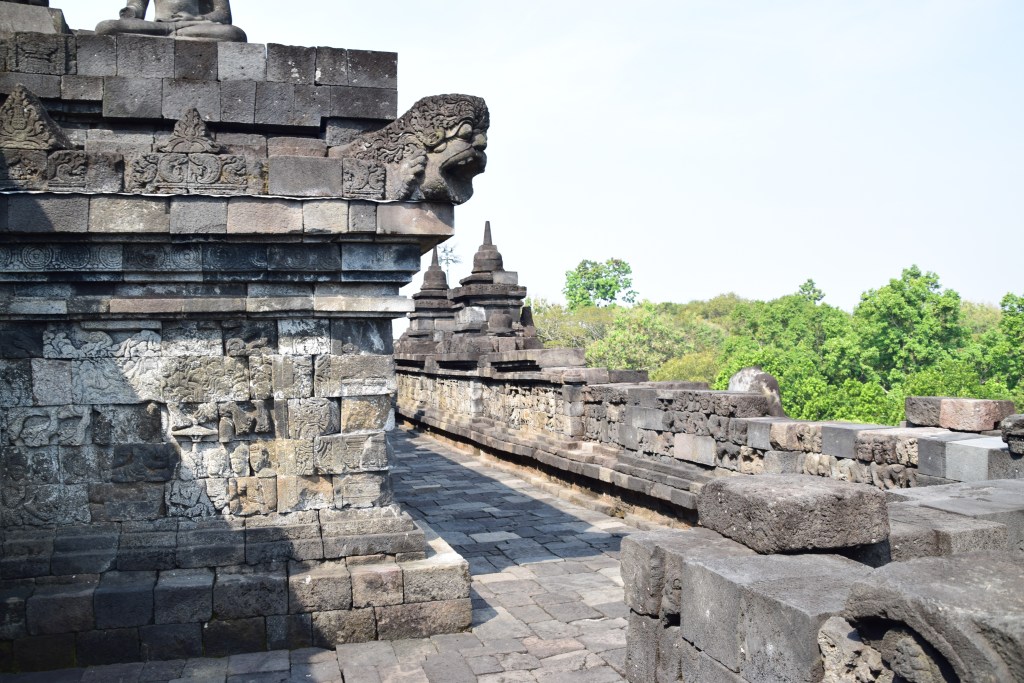
Gargoyles would have projected water away from the walls
A second massive campaign took place in the 1970’s, funded internationally and overseen by UNESCO. The lower terraces were dismantled, stone by stone – each block numbered, cleaned and treated with modern conservation methods before being replaced. A new drainage system was installed and the foundations reinforced to stop water seepage. By 1983, over a million stones had been removed and reassembled. Because it was mostly original materials used in the reconstruction – with some necessary additions to consolidate the structure – the integrity of the property has been maintained. It has been a World Heritage Site since 1991.


Panels with portions missing, heavy erosion or damage were left uncarved or filled in to maintain structural integrity rather than creating fake reliefs
Man may clean and rebuild but can’t do much about a volcanic location!! In 2010, Merapi erupted again. 2.5 centimetres of ash fell on the temple, filling the carvings and clogging the new drainage system. The clean-up was a major effort – the acidic ash had to be removed from the stone before it could do lasting damage. That latest restoration was officially completed in 2017.
Borobudur is the world’s largest Buddhist temple and ranks with Bagan and Angkor Wat among the great archeological sites of Southeast Asia. The growing rate of deterioration of building stone is closely monitored, as is the long-term impact of volcanic ash. A visitor management plan has been introduced to control overtourism. The site welcomes more than three million visitors a year who are permitted to walk along designated routes, accompanied by a mandatory guide. Quotas are in place – 1200 per day – and visitors wear special woven sandals called Upanat to help protect the stones.
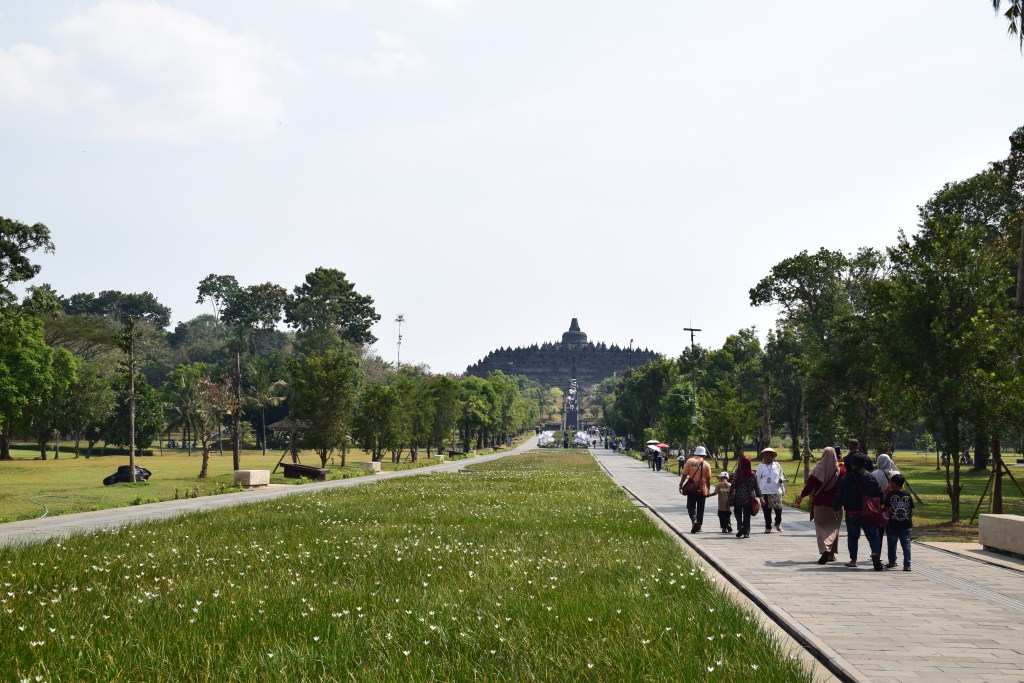
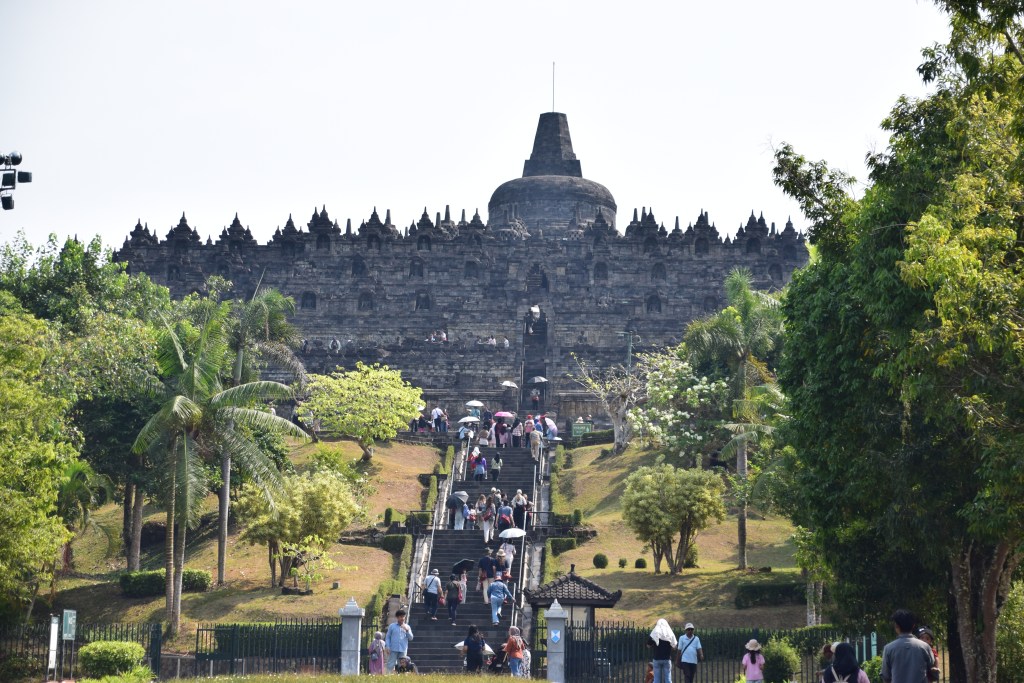
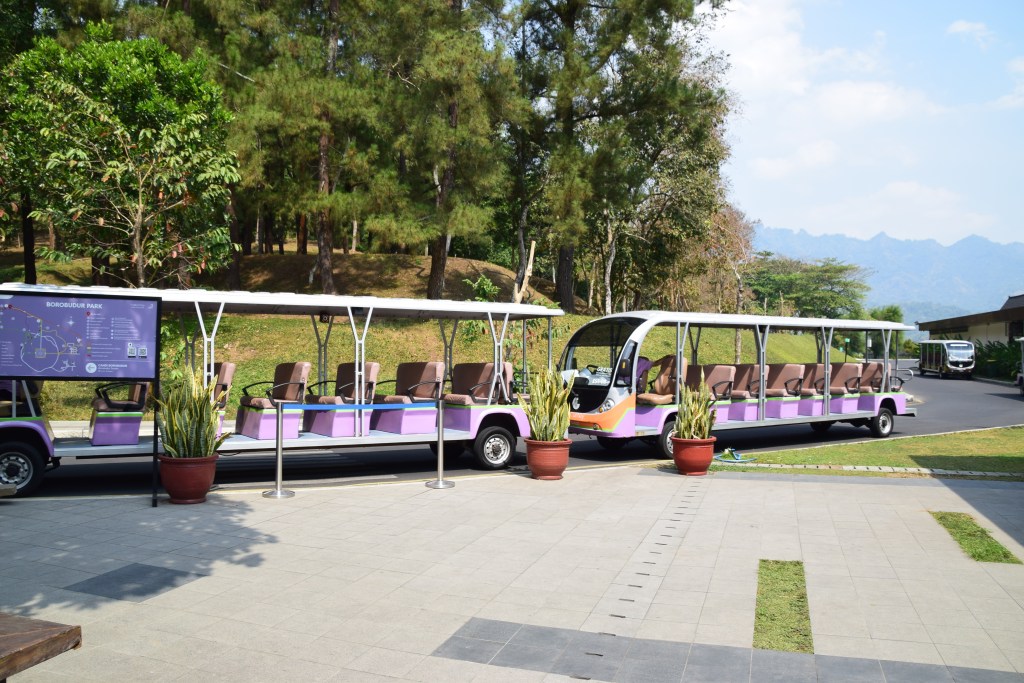


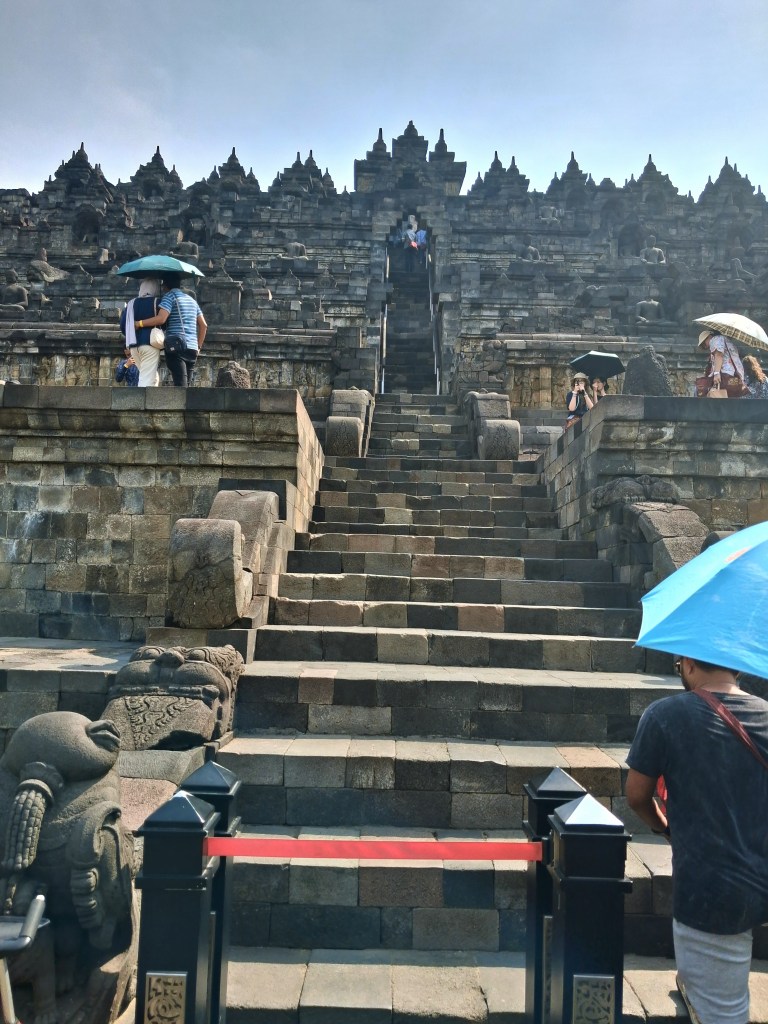
Entrance Fee is IDR455,000 (€23) and includes ticket, shuttle vehicle, guide and sandals (that you get to keep).
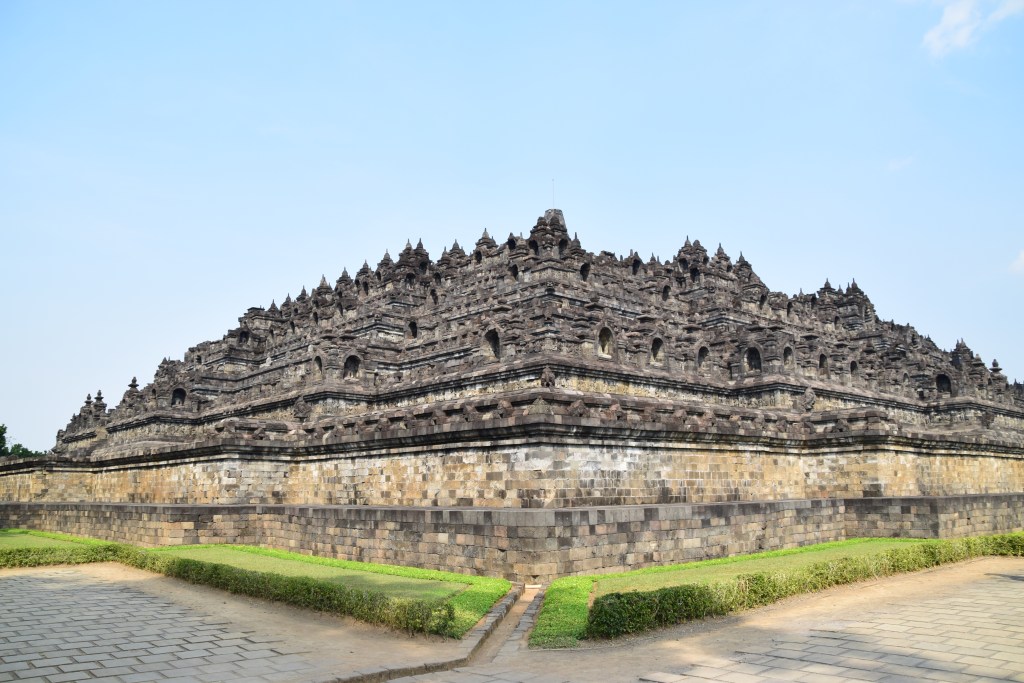

1872, (Courtesy, Wikimedia)
I would love to visit Borobudur – – thank you for your interesting commentary. The site looks awesome.
I feel very lucky indeed to get the opportunity to see such wonders. I never thought I’d get to Java…
What a stunning site!
It is – I’m sorry to admit I’d didn’t do much research beforehand so didn’t fully appreciate everything while I was there!
Borobudur has been on my list for a while. Your description of the panels in the base of the temple remind me of a Buddhist site we visted in Mrauk U in western Myanmar. Now I’m curious to see if there’s a connection. Maggie
There may well be – although I think the clan might have originated in India. I hope you get there one day, Maggie.
I’ve been dreaming of visiting Borobudur for a long time. Earlier this year, I’d finally booked a trip to Indonesia, planning to stop off in Java to see the temple. The trip included a stopover in the Persian Gulf, then events took a different turn. No Borobudur this year. But your presentation has made me even more keen to visit this place.
Yes – flights had settled back by the time we made the trip. Hope you get there another time. It’s a wonderful country.
We visited several years ago. Back then, you could explore on your own and wear your own shoes!
Ah – true intrepid travellers indeed! (although I really like the sandals!!!!)
I would really live to visit Borobudur and see it with my own eyes but until then your images amd informative descriptions at least help to bring it to life for me!
Ah thank you Sarah – no doubt it’s somewhere on your list!